| Brest |
| The military port of Brest (L'Arsenal de Brest) goes back as far as 1674 and has long been a strategic base for the maritime defence of France. As the centuries passed, drydocks, shipyards, naval buildings and infrastructure were built along the river Penfield and beyond so that today this military port is the second largest after Toulon. The photographs in this chapter illustrate the development of the dock infrastructure and the presence of French warships in the port from the 1800s onwards | |||||||||||||||||||||||||||||||||||||||||||||||||||||||||||||||||||||||||||||||||||||||||||||||||||||||||||||||||||||||||||||||||||||
|
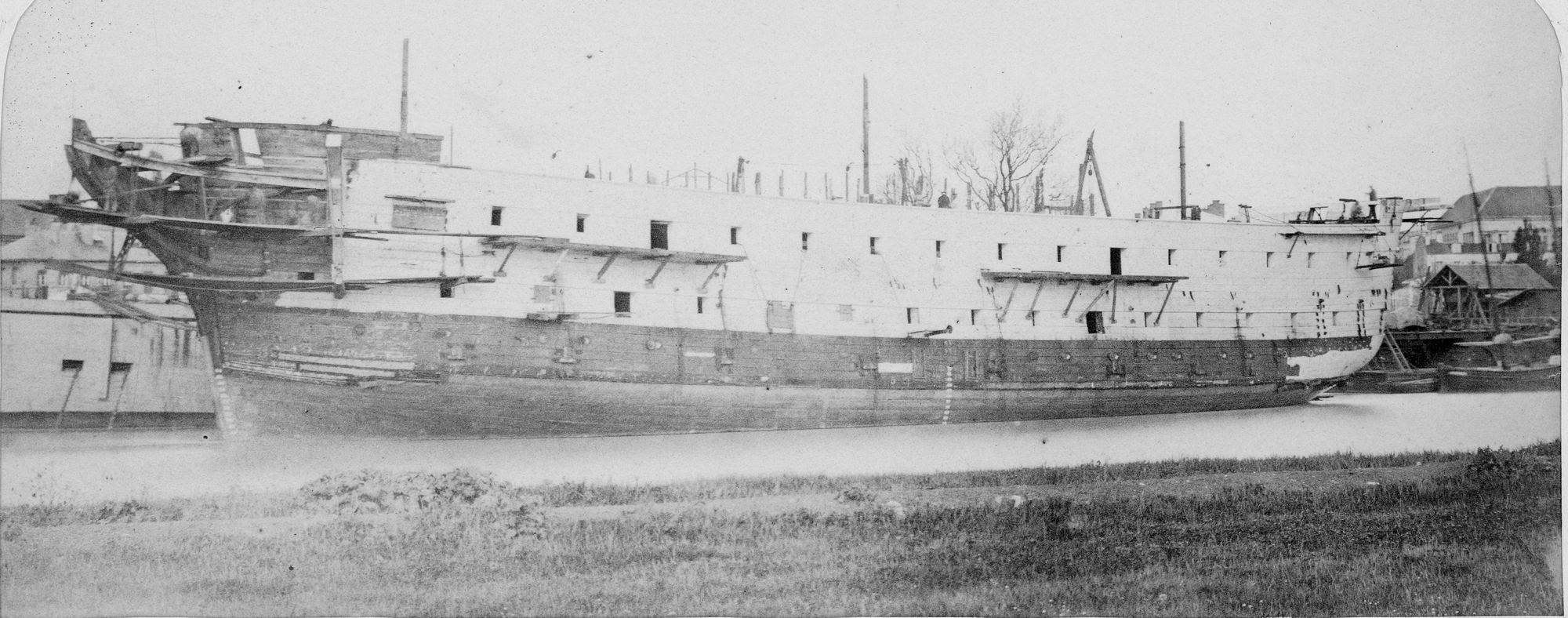
Catalogue number 104038 Frigate Pandore The French frigate Pandore was a 36 gun vessel laid down in the Brest Arsenal in 1829 and then was transformed to a mixed sail and steam frigate at Rochefort, 1868. Verso:"Pandore 6th May 1868. 20.9cm x 10.8cm Mounted albumen print |
 |
||||||||||||||||||||||||||||||||||||||||||||||||||||||||||||||||||||||||||||||||||||||||||||||||||||||||||||||||||||||||||||||||||
|
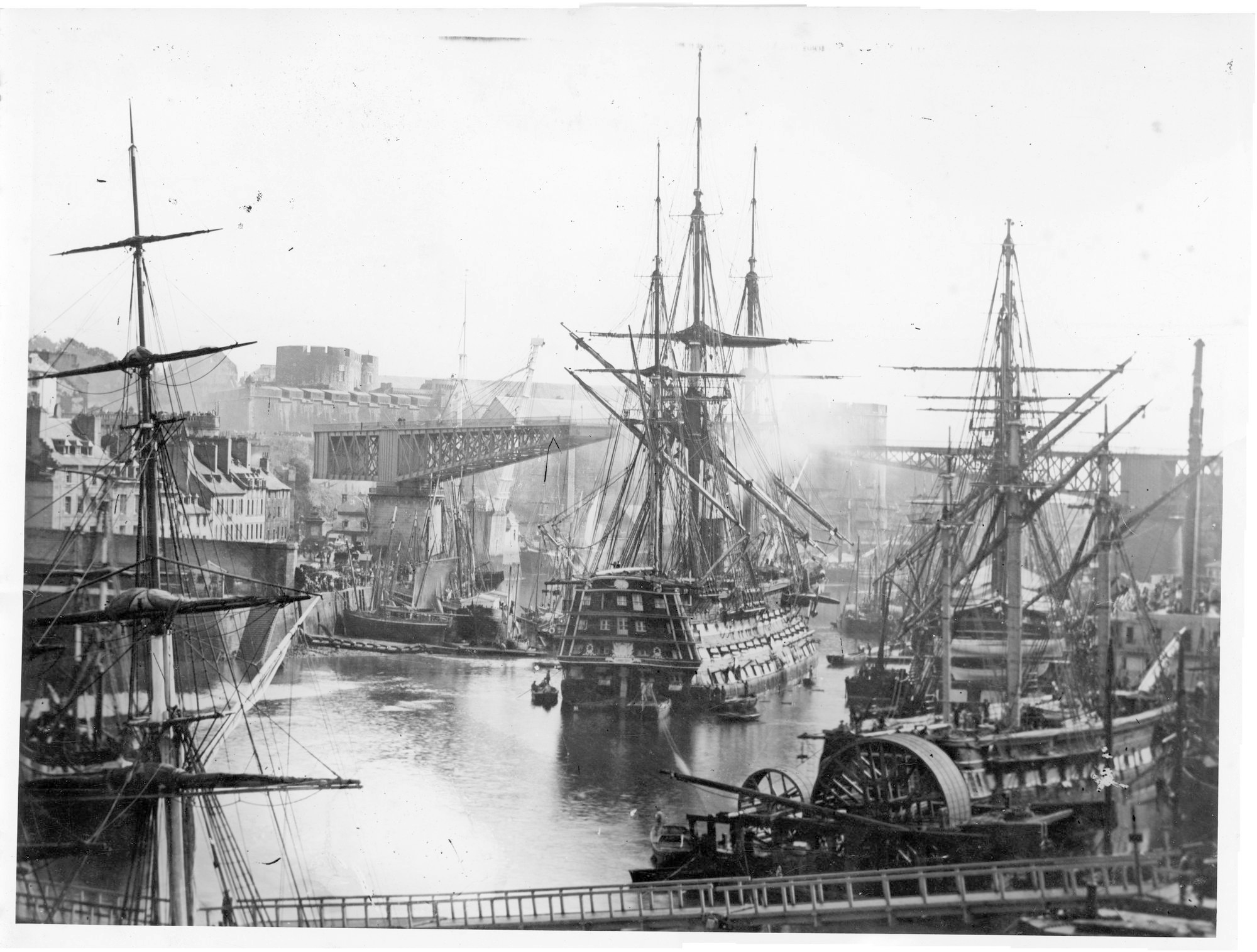
Catalogue number 86 F1 Louis XIV passing through the bridge. Louis XIV was a 114 gun (sources vary, 120)three-decker launched in 1852 (although laid down in 1811!) at Rochefort. After working essentially as a troop transport of the Crimean War, she became the gunnery school at Brest in 1863 before moving on to Toulon. Note the man-powered dredger bottom right. Men walking in the circular cage work the scoop that digs out the mud and silt. Verso:"Brest in 1851" in ballpoint pen 38cm x 28cm Gelatin silver print |
 |
||||||||||||||||||||||||||||||||||||||||||||||||||||||||||||||||||||||||||||||||||||||||||||||||||||||||||||||||||||||||||||||||
|
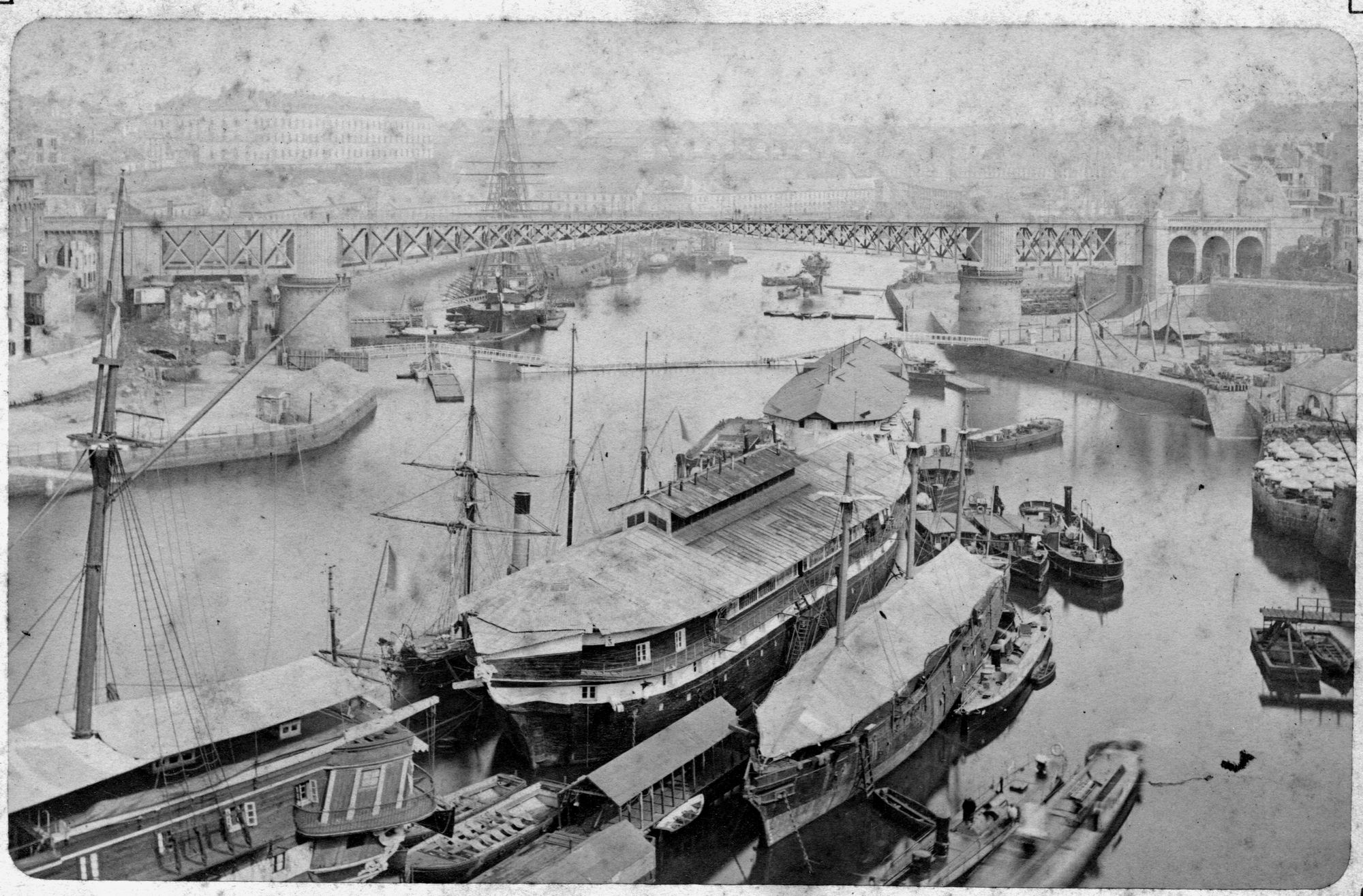
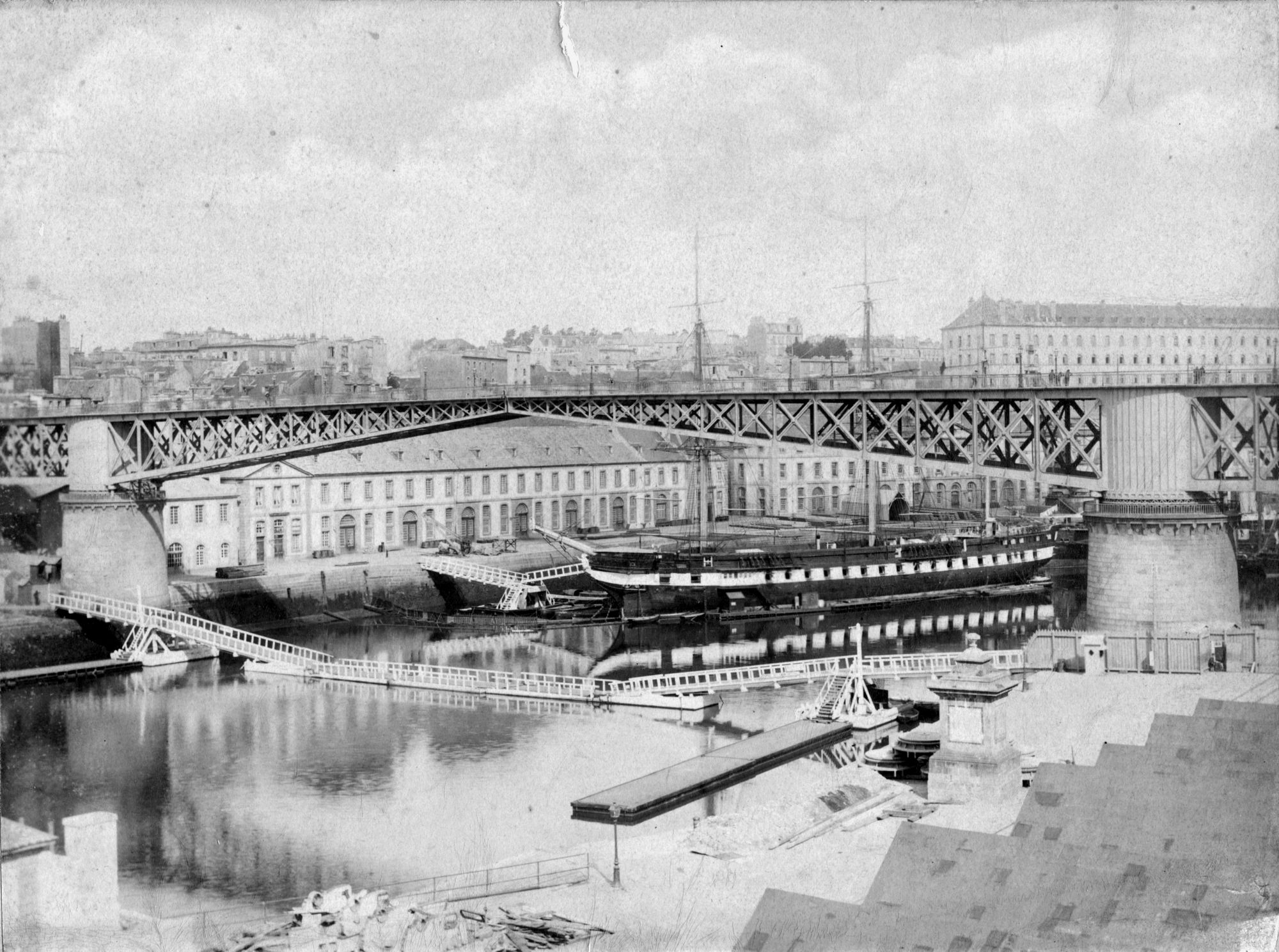
Catalogue number 82004 Port Militaire.- Le Pont Tournant Old ships of the line transformed into workshops and accommodation. Probably the frigate Flore after the bridge, was a sea-going school for midshipmen in 1876 to 1882. Note the two-span rotating bridge and below, the floating walkway. 15.7cm x 10cm Mounted albumen print |
 |
||||||||||||||||||||||||||||||||||||||||||||||||||||||||||||||||||||||||||||||||||||||||||||||||||||||||||||||||||||||||||||||
|
Catalogue number 30011 Maybe the transport Tage Entering the port is a delicate manoeure with many different types of vessel tied up. Note the paddleship tug after the rotating bridge and the floating walkway drawn back to allow the passage of the ship. 13.9cm x 9.1cm Printed image |
 |
|
Catalogue number 28023 Two-decker ship of the line Again, this may be the ship Tage in Penfield at Brest around 1880 (cf French Warships in the Age of Steam 1859-1904, page 19). The ship to the left with sails out may be the frigate Flore. Behind the right arm of the turning bridge we can see a ship under construction. Off the starboard bow of Tage is the structure used to breakup the rocks on high points of the seabed at the entrance to the port(see catalogue number 28012 and 82004). Recto:"Brest. A transport entering the military port" in French 14.7cm x 9.5cm Mounted albumen print |
 |
||||||||||||||||||||||||||||||||||||||||||||||||||||||||||||||||||||||||||||||||||||||||||||||||||||||||||||||||||||||||||
|
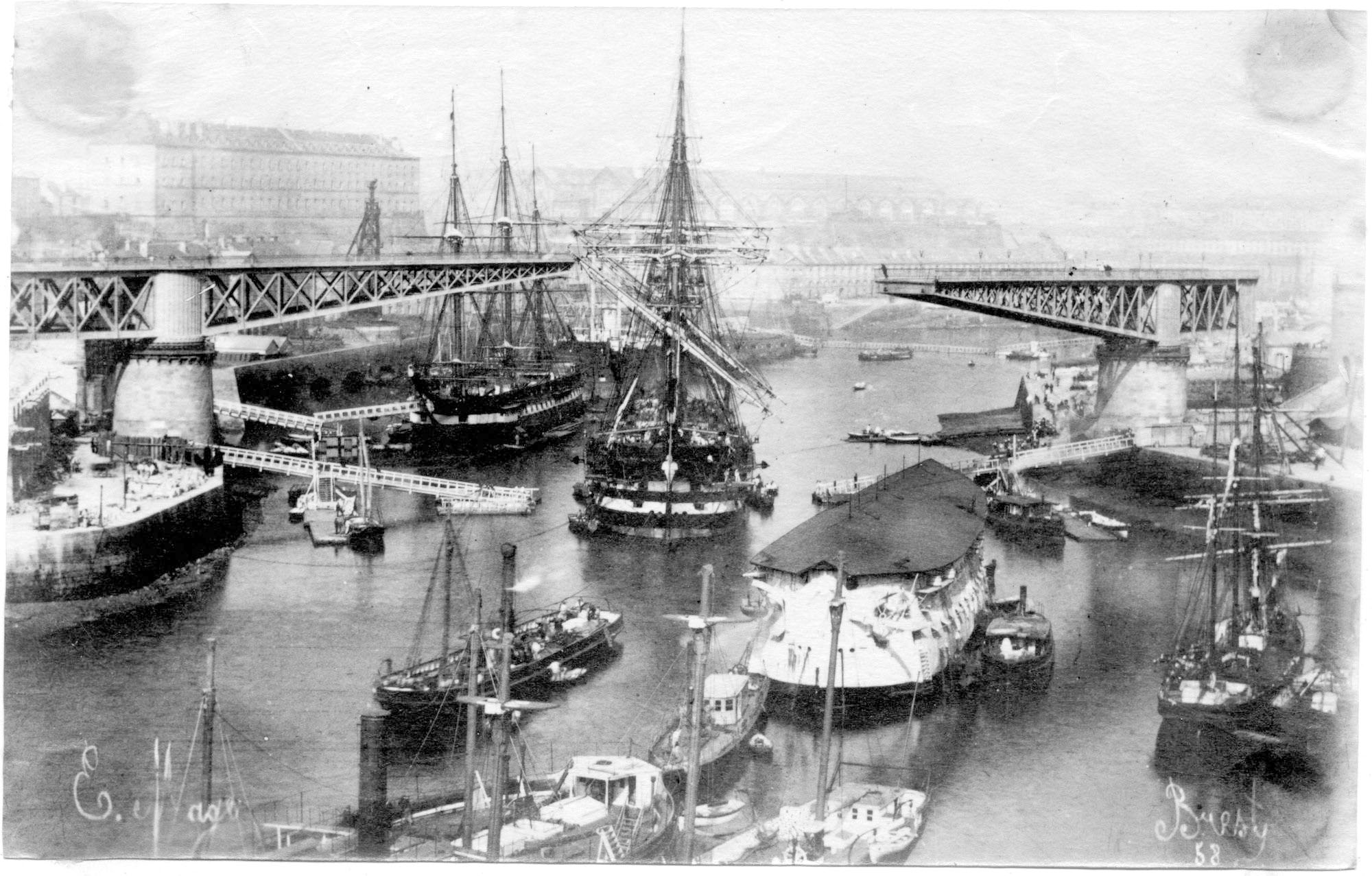
Catalogue number 35073 Two-decker leaving the port Another good view of probably Tage leaving the port under tow. Recto:"Brest. The bridge open." in French 17.6cm x 10.5cm Mounted albumen print |
 |
|
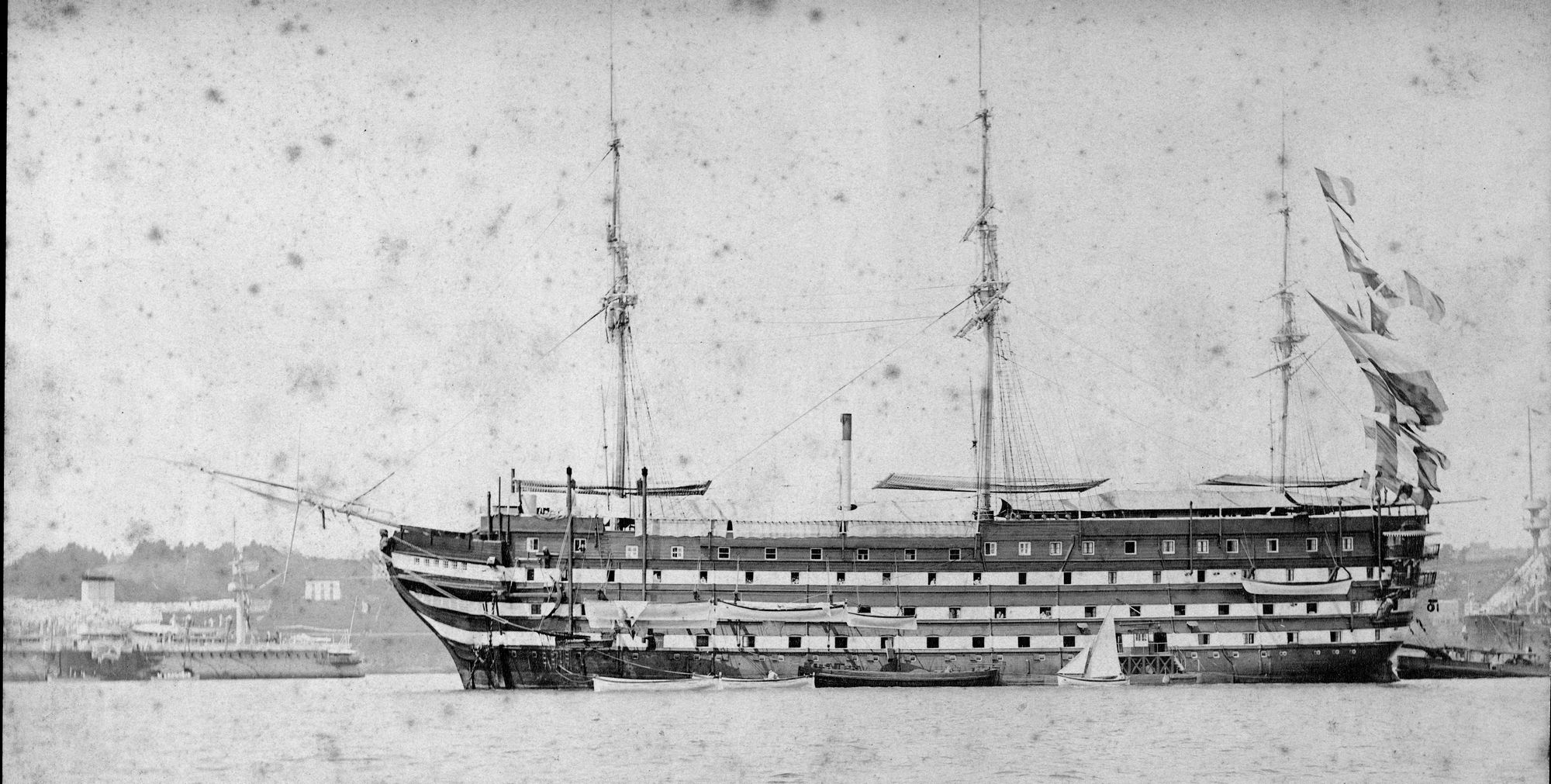
Catalogue number 87 F4 Le Borda, Brest Although outdated when finally completed, the Borda had a varied career, launched Rochefort 1864 as the troopship Intrepide seeing action in Mexico and Sfax, she was condemned in 1887 and after a third deck was added at Toulon 1887-1889, went to Brest as the school ship for the Naval Academy. Note the sailing cutters alongside and French ensigns flying from the mizzen mast. Recto:"BREST "Le Borda" 267 1053 N.D, Phot." in gold lettering 27.5cm x 21.3cm Mounted albumen photo on black card, text in gold lettering and gold edges to mount print |
 |
|
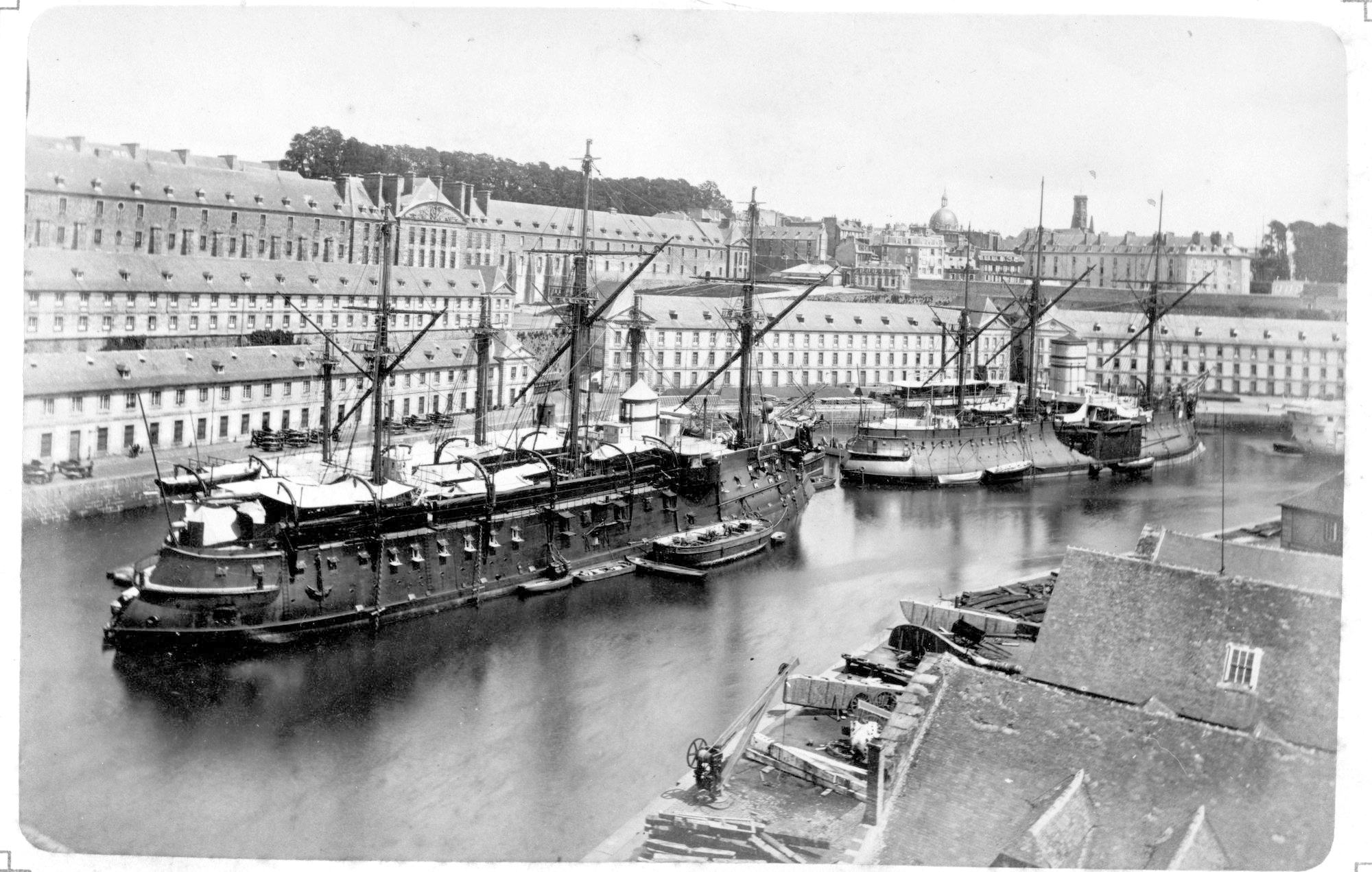
Catalogue number 82004 Iron-clads Colbert and Redoutable Colbert with large Captain's sternwalk (left) and Redoutable with one large funnel amidships (right). Wooden-hulled battleships with cast-iron armoured belt above and below waterline. Both vessels were completed ship-rigged but were soon reduced to barque-rigged then to barquentines with military masts and fighting tops.This photograoh shows both ships after completion. Recto: "Port militaire. - Vue prise du Viaduc" "Military port, view from the bridge" 15.7cm x 10.1cm Mounted albumen print. Note: the catalogue numbers 82004 are in a small bound album of eleven gold-edged, mounted albumen photographs entitled "Souvenir de Brest" edited by Nogue (active in the late 1880s), 29 31 rue de Siam Brest. |
 |
|
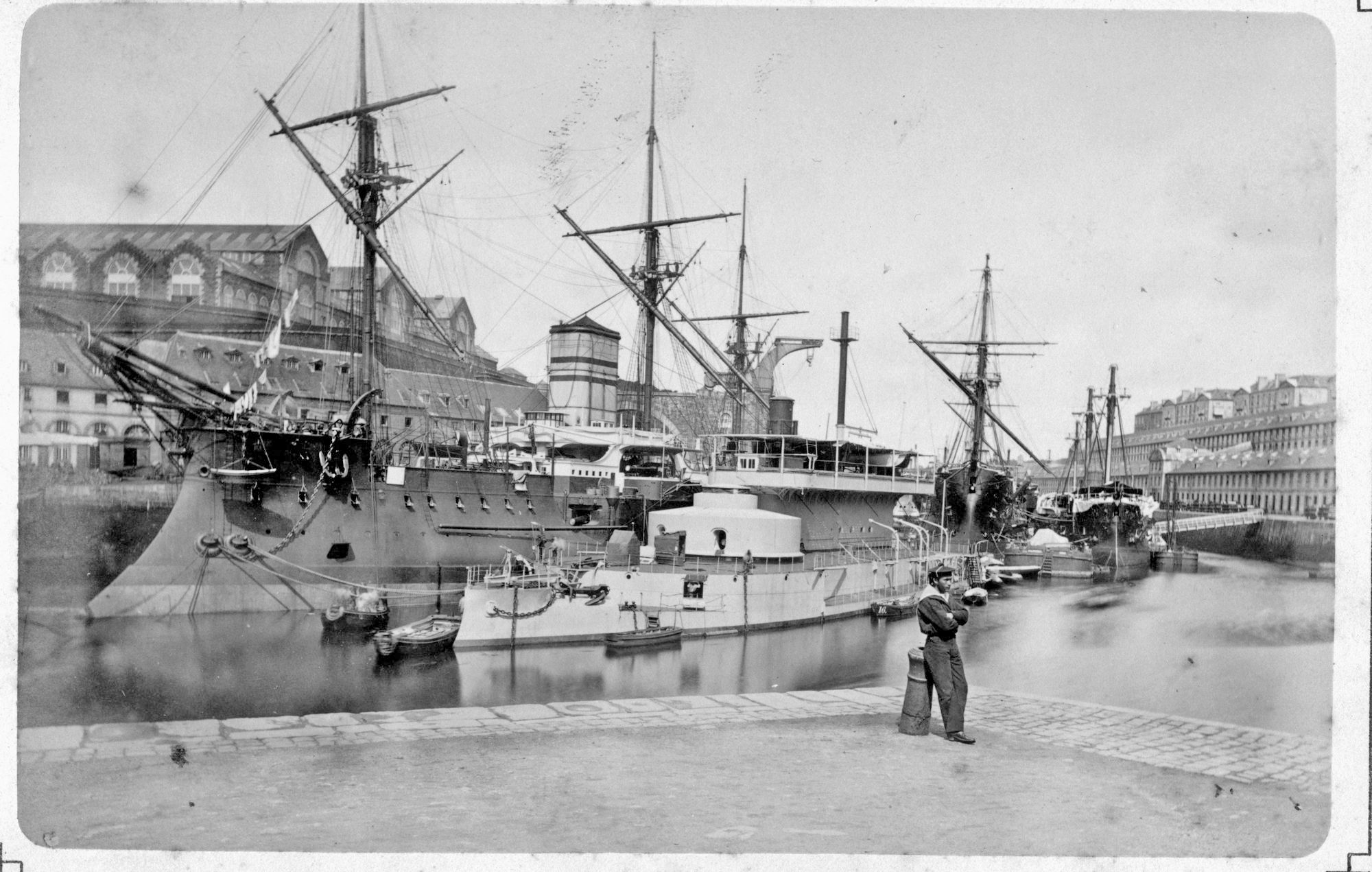
Catalogue number 82004 Redoutable and Tempete Two fine-looking vessels, the central battery ship Redoutable alongside Tempete, one of the two Tempete class breastwork monitors. Recto:"Military port.- monitor and armoured cruisers." in French 15.6cm x 10.1cm Mounted albumen print |
 |
|
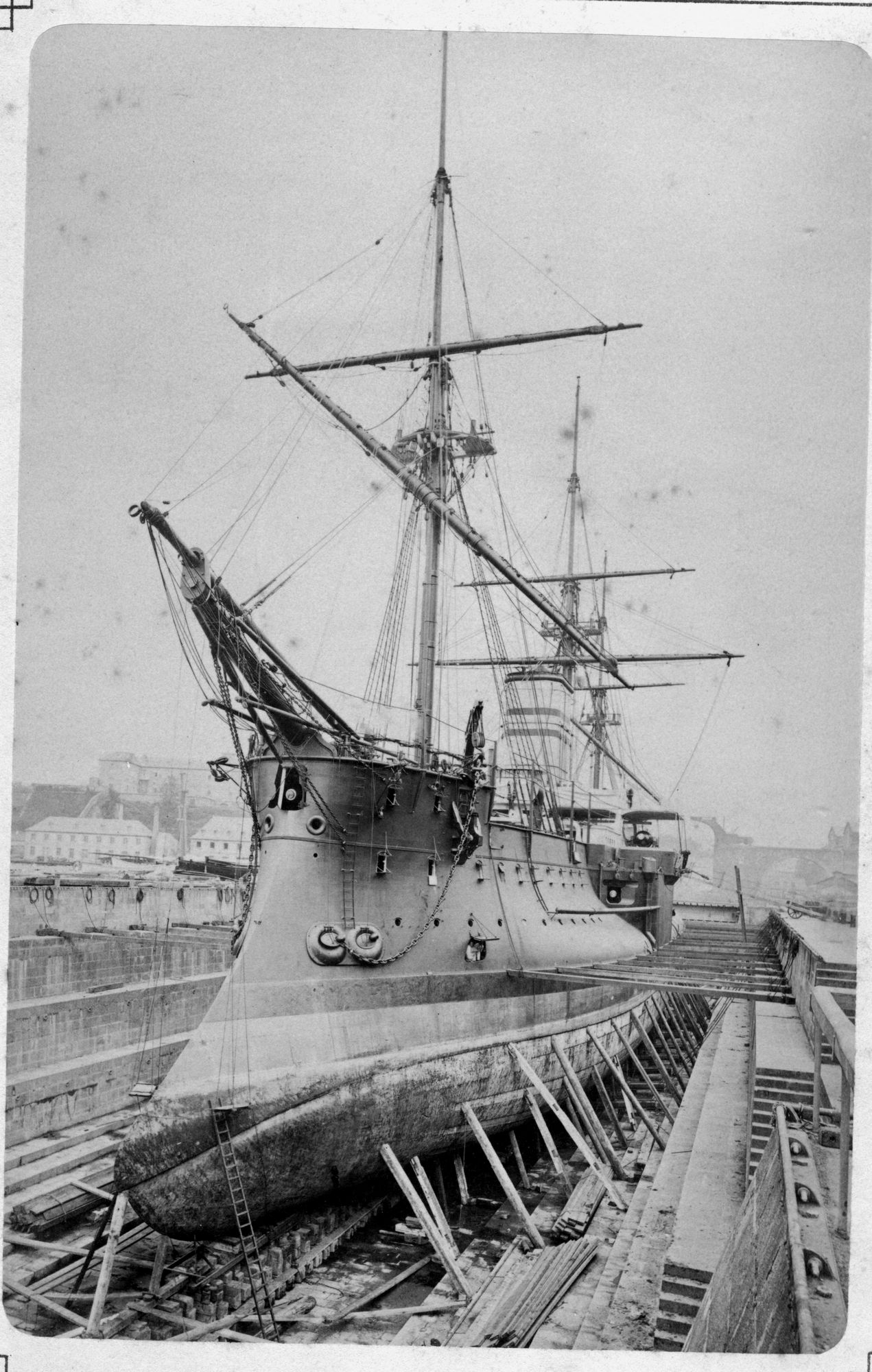
Catalogue number 82004 Redoutable in drydock Redoutable was laid down in Lorient and is shown here as built with eight 274.4mm guns, four in midship batteries with a single gun above each battery plus one gun under the forecastle and one in the stern. In this photograph, we can see the port battery and the forecastle gun right forward. Recto:"Military port.- 1st class armoured cruiser in drydock 10.1cm x 15.6cm Mounted albumen print |
 |
|
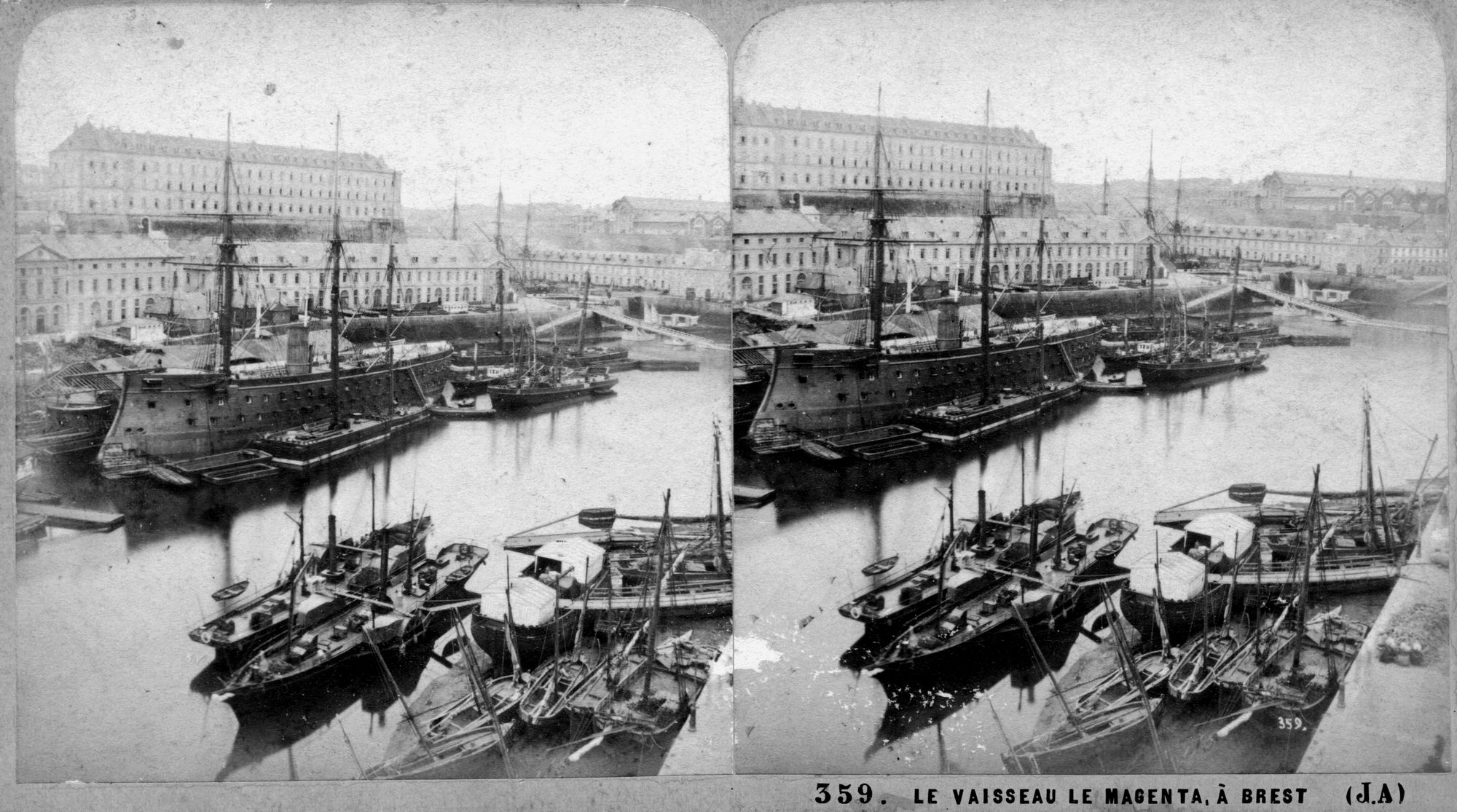
Catalogue number 28014 Ironclad Magenta The Magenta was a two-deck broadside ironclad laid down in Brest 1859 and fitted with a steel-sheathed spur ram although the ram is not yet fitted in this photograph. Note the two paddleship tugs just left of center. 14.9cm x 8cm Mounted albumen print |
 |
|
Catalogue number 30016 Ironclad Magenta during construction Note the funnel midships, the heavy wooden timbers of the hull and the spur ram seems to be in place. 8.1cm x 13.4cm Gelatin silver print |
 |
|
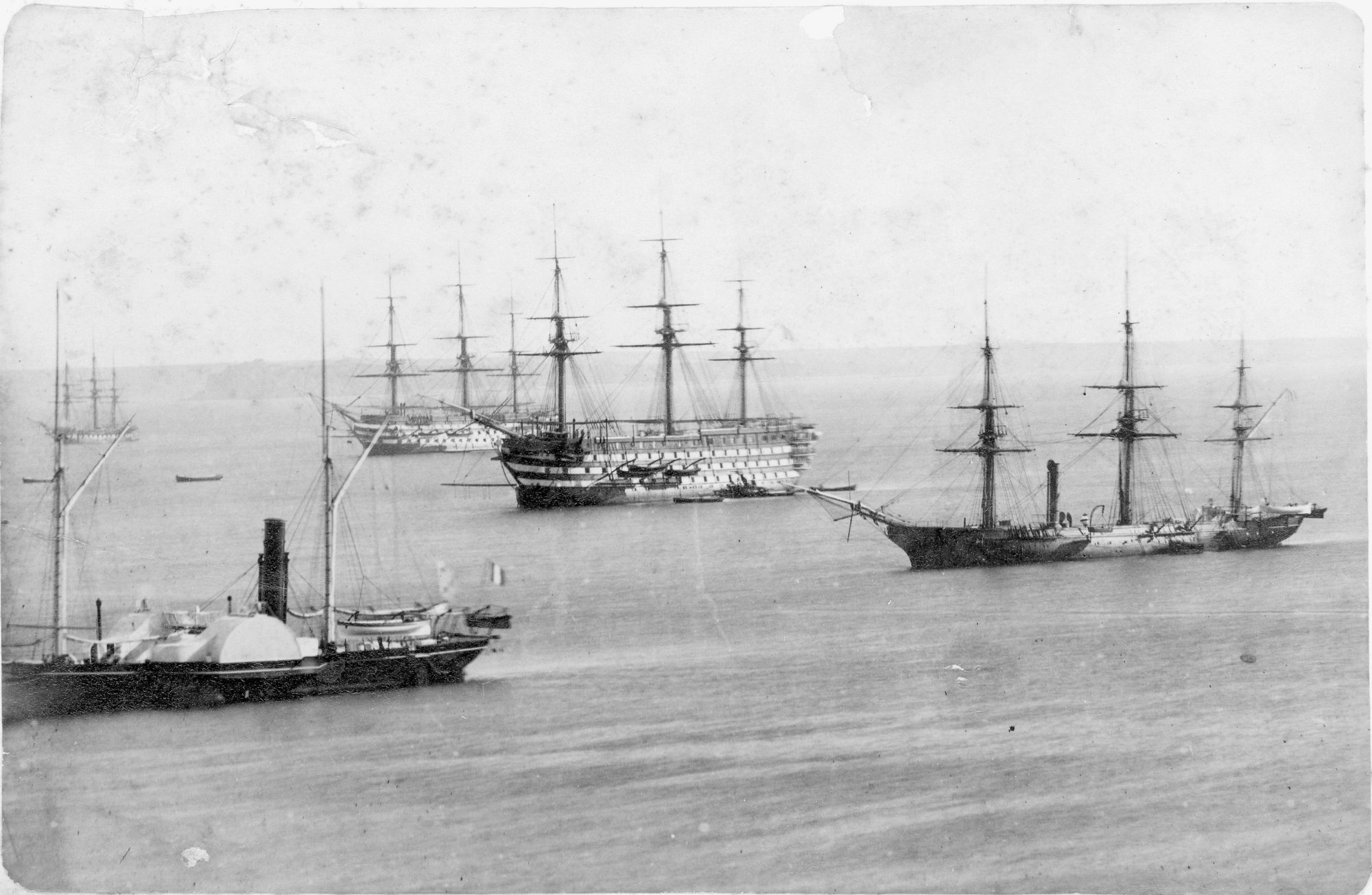
Catalogue number 82004 Ships of the Line, anchored off Brest Possible identification: left Bretagne,second from left Borda and Bougainville center. Right are two frigates and a two-decker to be identified. Recto:" Le Rade" 15.9cm x 9.8cm Mounted albumen print |
 |
|
Catalogue number 154018 Ships of the Line, anchored off Brest Possible identification: background, second from left Bretagne, center Borda, right Bougainville with a steam paddle ship left foreground and a small frigate left background. Recto:"Brest Rade 15.2cm x 11.8cm Mounted albumen print |
 |
|
Catalogue number 88 F6 Converted sailing frigate Flore. Flore in the anchorage off Brest with Borda and Bretagne in the background. Converted on the stocks to a screw frigate and launched 1869, Flore was flagship to the Pacific station and after a period in reserve became a sea-going training ship at Brest. She eventually became the harbour flagship and school for seamanship 1888 to 1899, finally to be broken up 1901. 28.5cm x 19.6cm Mounted albumen print |
 |
|
Catalogue number 90 F7 The frigate Flore along the quayside Flore being readied for her new duties. Recto:"Brest. The rotating bridge" in French 22.4cm x 16.7cm Mounted albumen print |
 |
|
Catalogue number 41250 Navire Admiral This unknown ship, maybe Donawerth a 3rd rank two-decker, was called the "Amiral" in the military port and probably served for training and accommodation, note the cutdown masts. She was replaced by Flore. 14.1cm x 9.1cm Printed image |
 |
|
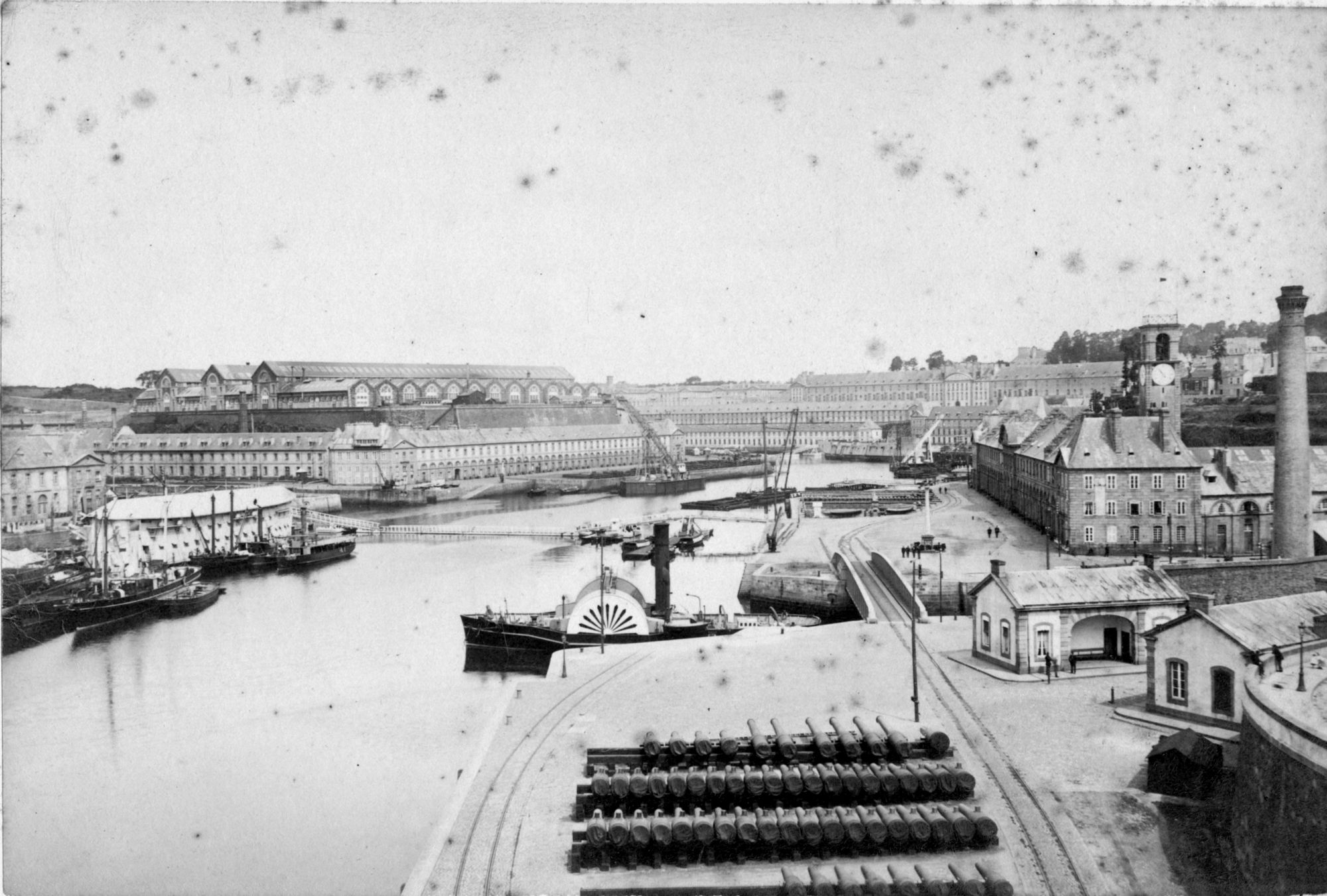
Catalogue number 90 F7 View from the bridge A steam paddle tug tied up by the quay with gun barrels stored, an hulked two-deck to the left. Recto:"Brest. Military port" in fine black ink 17.5cm x 11.8cm Mounted albumen print |
 |
|
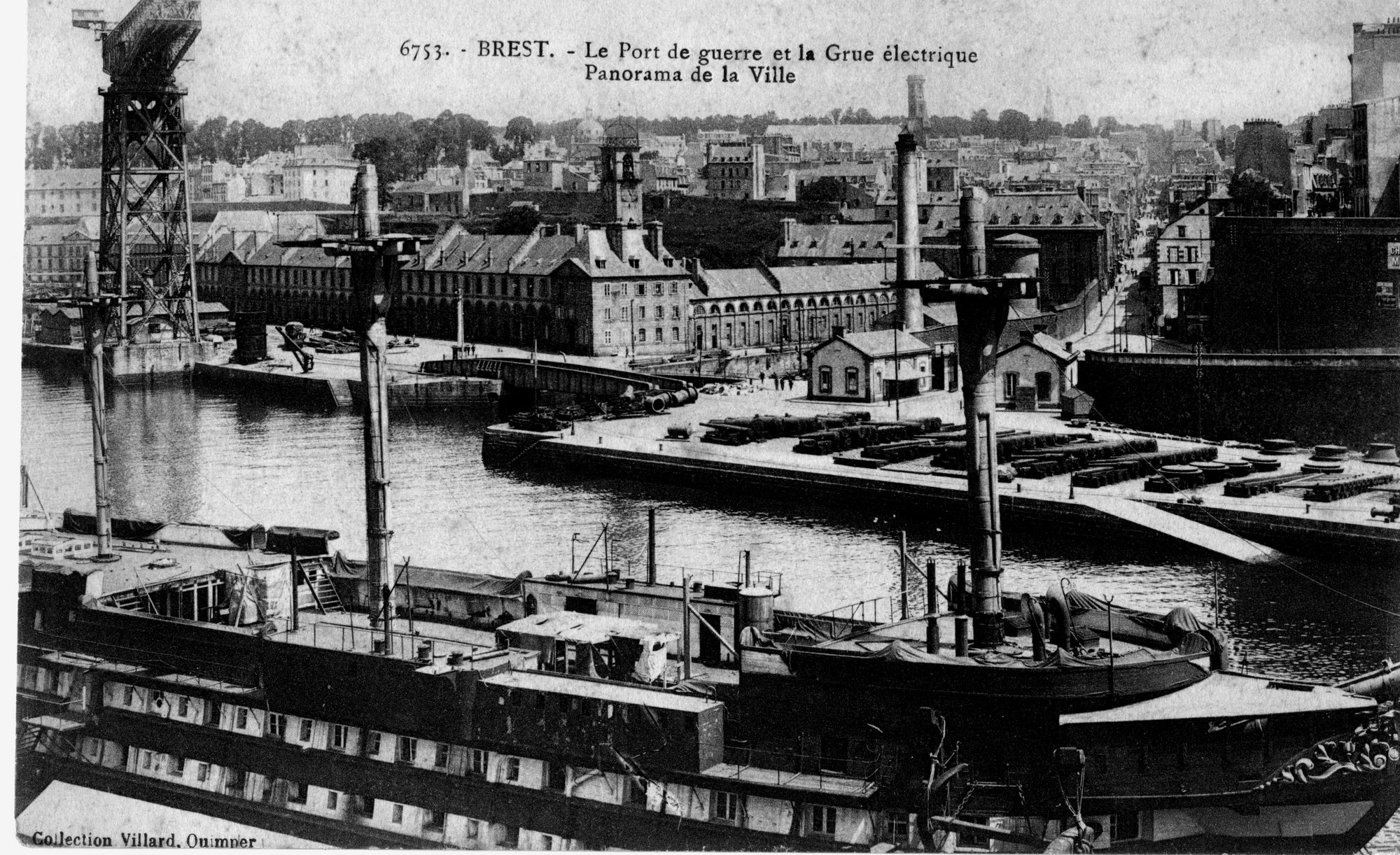
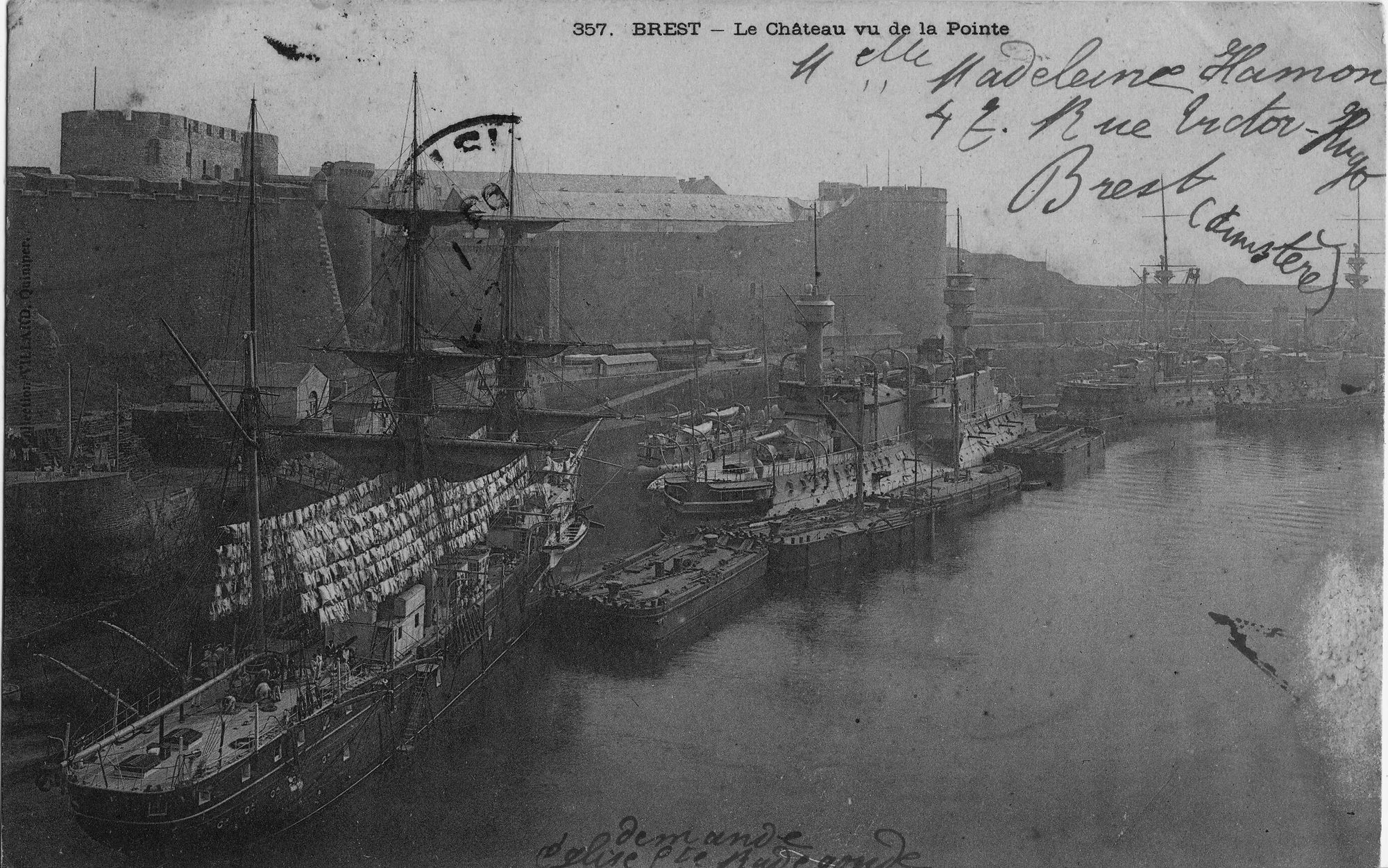
Catalogue number 35229 Hoche and Amiral Duperre In this postcard posted in 1919, we can see a training ship with the washing out, the battleship Hoche and the ironclad Amiral Duperre. These two vessels were not successful, Hoche was top-heavy with the built-up superstructure, the foredeck awash in anything but a light sea, Amiral Duperre with guns that could not be trained simultaneously and a slow rate of fire (7 to 15 minutes per round) due to the single pressurized water pump for pointing and loading. From 1898, Amiral Duperre and other old battleships joined the Escadre du Nord and to reserve in Brest in 1901. 13.8cm x 8.8cm Printed image |
 |
|
Catalogue number 111091 Old ships of the line by the Chateau As steam propulsion and steel hulls replaced sail and wood, the old sail ships were decommissioned. Here, four hulked old sailing ships moored at the foot of the Chateau. 16.9cm x 10.3cm Albumen print |
 |
|
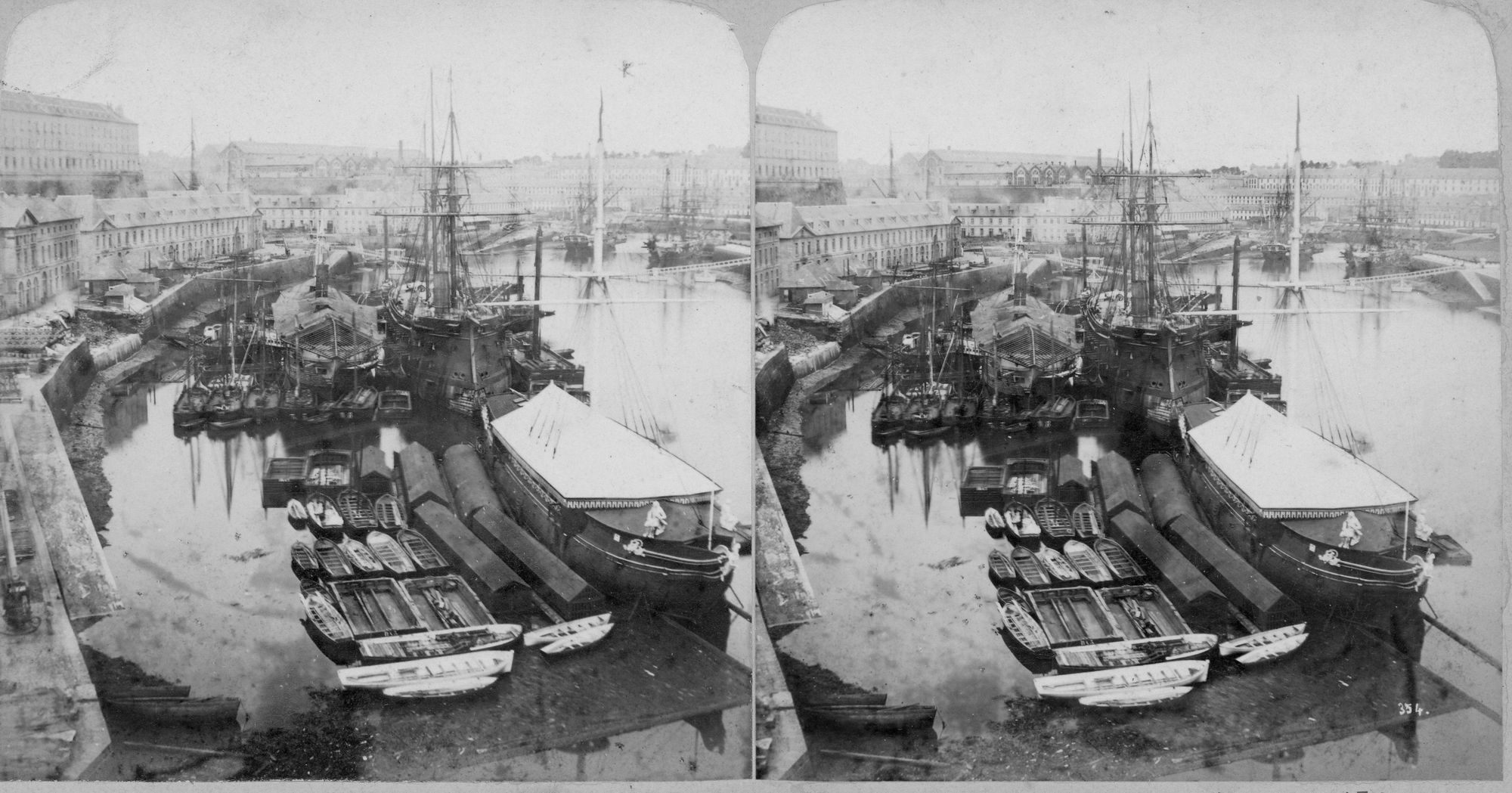
Catalogue number 137062 Is the "Amiral" the vessel foreground right with the winged figurehead? The ironclad Solferino or Magenta is center, note the abscence of the steel ram. In the background are several sailing ships, their days numbered Recto:"354.The Admiral and the port in Brest (J.A)" in French 15.3cm x 8cm Mounted stereo albumen print |
 |
|
Catalogue number 88 Hoche being moved out of harbour Hoche was in Brest from 1889 to 1891 for trials. As completed, the ship has two heavy military masts, the after mast only being removed in 1894-95. Recto:"Brest.- The turntable bridge. Brest in the main highway of the French maritime forces. The military port can hold a full fleet. It is a kind of canal 5 kilometers long and 100 meters wide cut out of the rock, at the mouth of a small but capricious river called the Penfield. The turntable or rotating bridge that links the two hills of Brest and of the Recouvrance will always be seen as one of the most remarkable exploits of human engineering. It is made up of two iron spans weighing 750 tones yet can be manoeuvred by four men. It requires only ten minutes to open or close the bridge, letting pass our formidable battleships. Overall span is 117 meters for a heigth of 20 meters. a floating bridge of pedestrians joins the two river banks. It is from the top of this bridge that one can appreciate its importance and judge the prowess of human activity." in French 25cm x 20cm Printed image |
 |
|
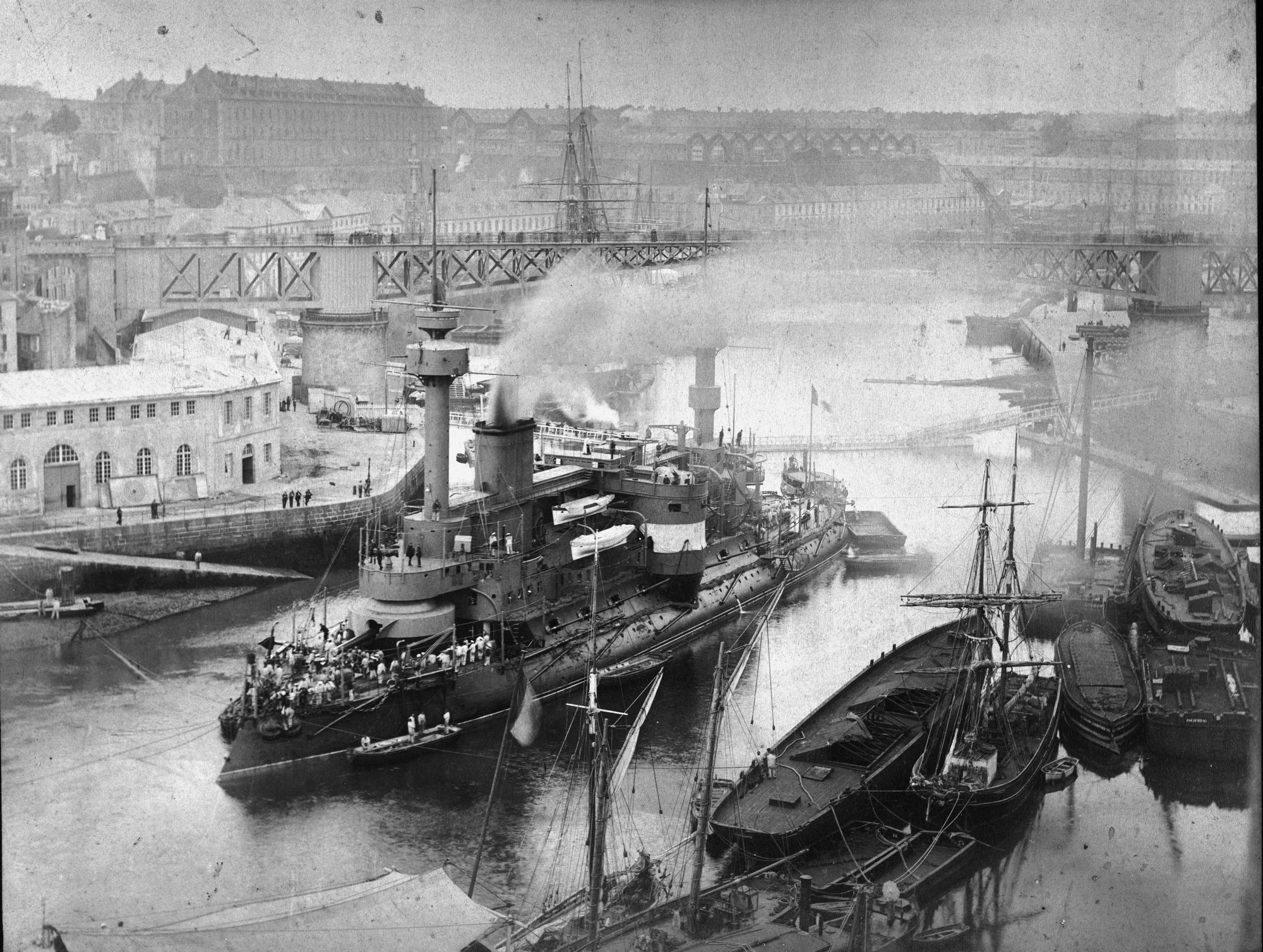
Catalogue number 87 F4 Battleship Hoche easing out of Brest Hoche is seen here being eased out of the harbour in Brest. The turntable bridge has been partially opened to let the masts go through, the ship's boats are busy around the vessel as are the crew on the foredeck. Note the men on either bank of the channel with lines out to the ship. In a manner similar to "at sea refuelling" today, the lines serve to give an indication of the ships position as regards the river banks. The after military mast is still in place and the superstructure has not yet been cut down which dates this photograph pre-1894. Recto:"Port Militaire de Brest 252 Sortie du Cuirasse "Le Hoche" in gold lettering and borders Credit: N.D, Phot. 26.1cm x 20.7cm Mounted albumen print |
 |
|
Catalogue number 23036 French battleship Charlemagne at Brest Charlemagne is seen here leaving Brest, note the absence of guns and turrets. The guns and turrets of Charlemagne and her two other sister ships were delivered late and the ships ran their trials without the main armament. Despite the shorter and lighter military masts compared to Hoche, the Charlemagne class were considered unstable. Recto:"Brest. The battleship "Charlemagne" leaving the military port" in French and in black ink 14cm x 9.2cm Gelatin silver print |
 |
|
Catalogue number 90 F8 Built in the Arsenal of Brest, the Suffren was launched in 1899 and not in 1898 as given in the text accompanying the photograph. Tugs hold on to the two hawsers ready to pull should the ship not leave the slipway. Recto:"Launch of the battleship "The Suffren" - Brest 25th July 1898 (sic) in French and in fine black ink 22.3cm x 15.3cm Mounted albumen print |
 |
|
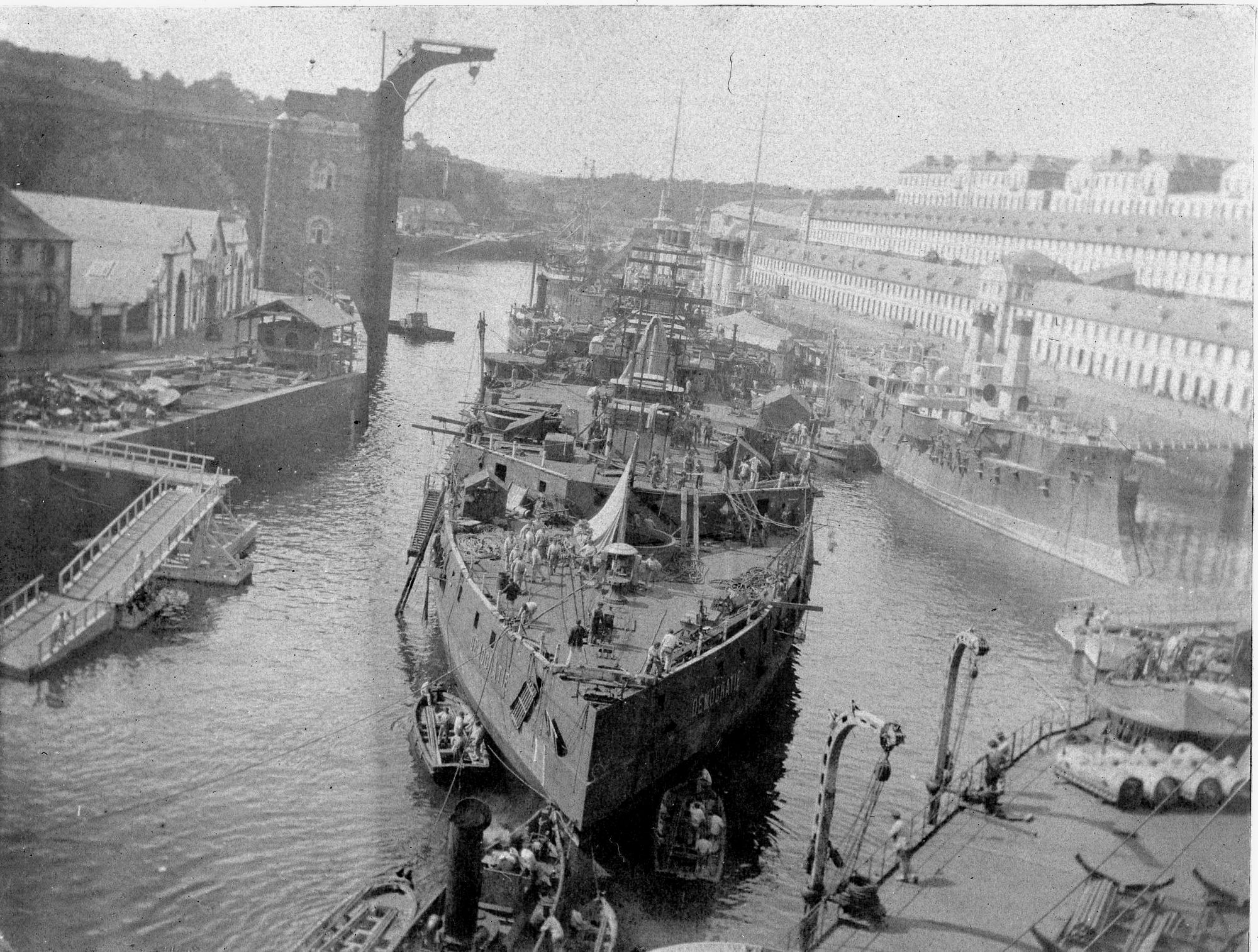
Catalogue number 101179 Battleship Democratie under construction, Brest Democratie is being worked through the channel to go on for fitting-out basin. Note the canvas covers over the gun emplacement should it rain in Brest. Recto:"1900-1905 Patrie Suffren Republique Justice Verite Democratie Liberte (destroyed) 1900-1905 Democratie in the arsenal at Brest" in French and in light pencil Verso:"The battleship Democratie under contruction in the arsenal, Brest" in French and in light pencil on the verso of an invitation card dated May 1906 10.3cm x 7.8cm Mounted albumen print |
 |
|
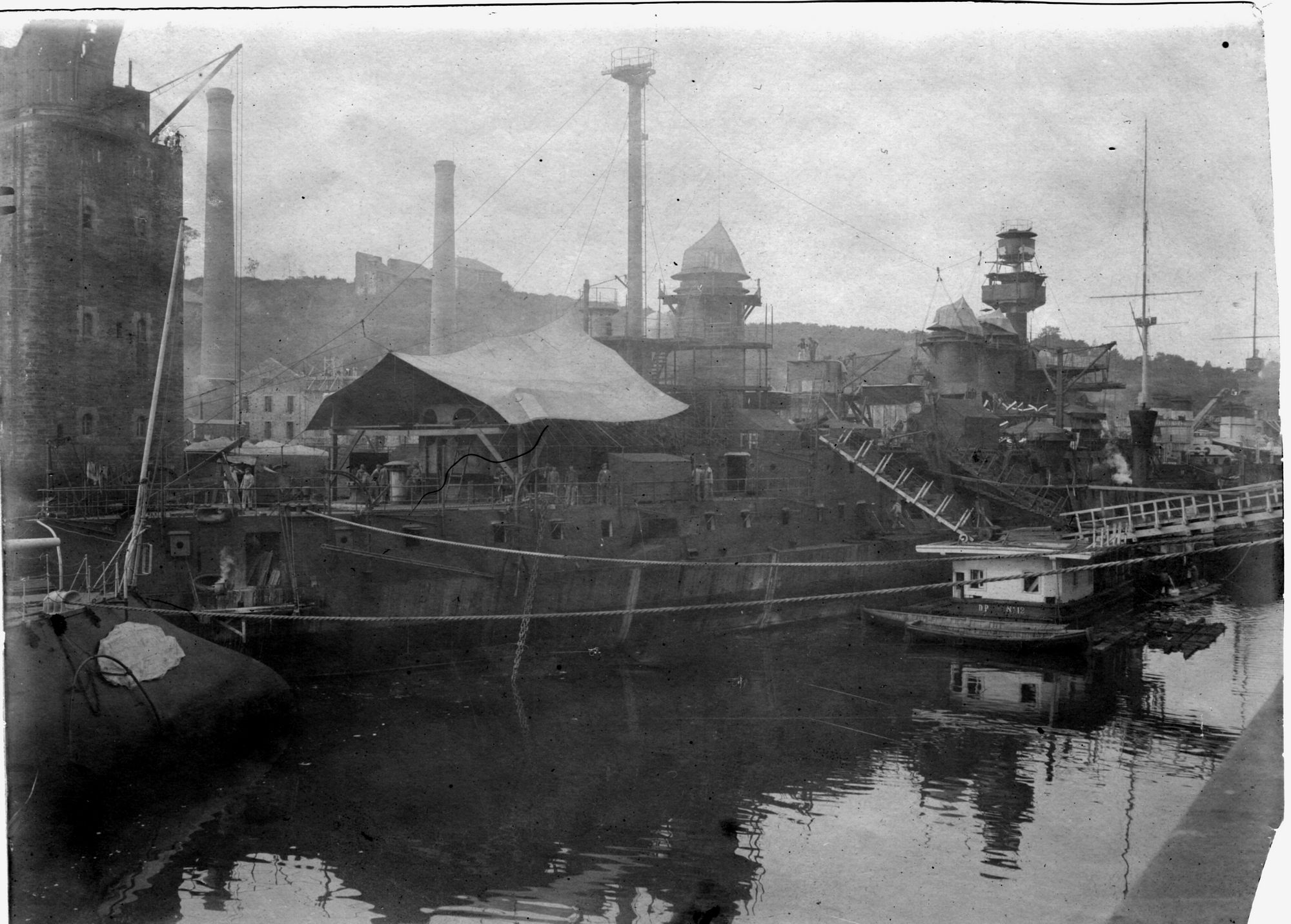
Catalogue number 45228 Battleship Democratie, fitting-out basin, Brest After the previous photograph, Democratie is now at the fitting-out basin under the masting crane. The stern turret is in place awaiting its guns. Funnels and the turret are covered again should it rain in Britany. Verso:"Battleship "Democratie" Our new battleships. The new battleship "Democratie" fitting out in the arsenal of Brest "Democratie" Sent 11th July (to/from) place des Jacobins at Morlaix Finnistere" 17.2cm x 12.6cm Albumen print |
 |
|
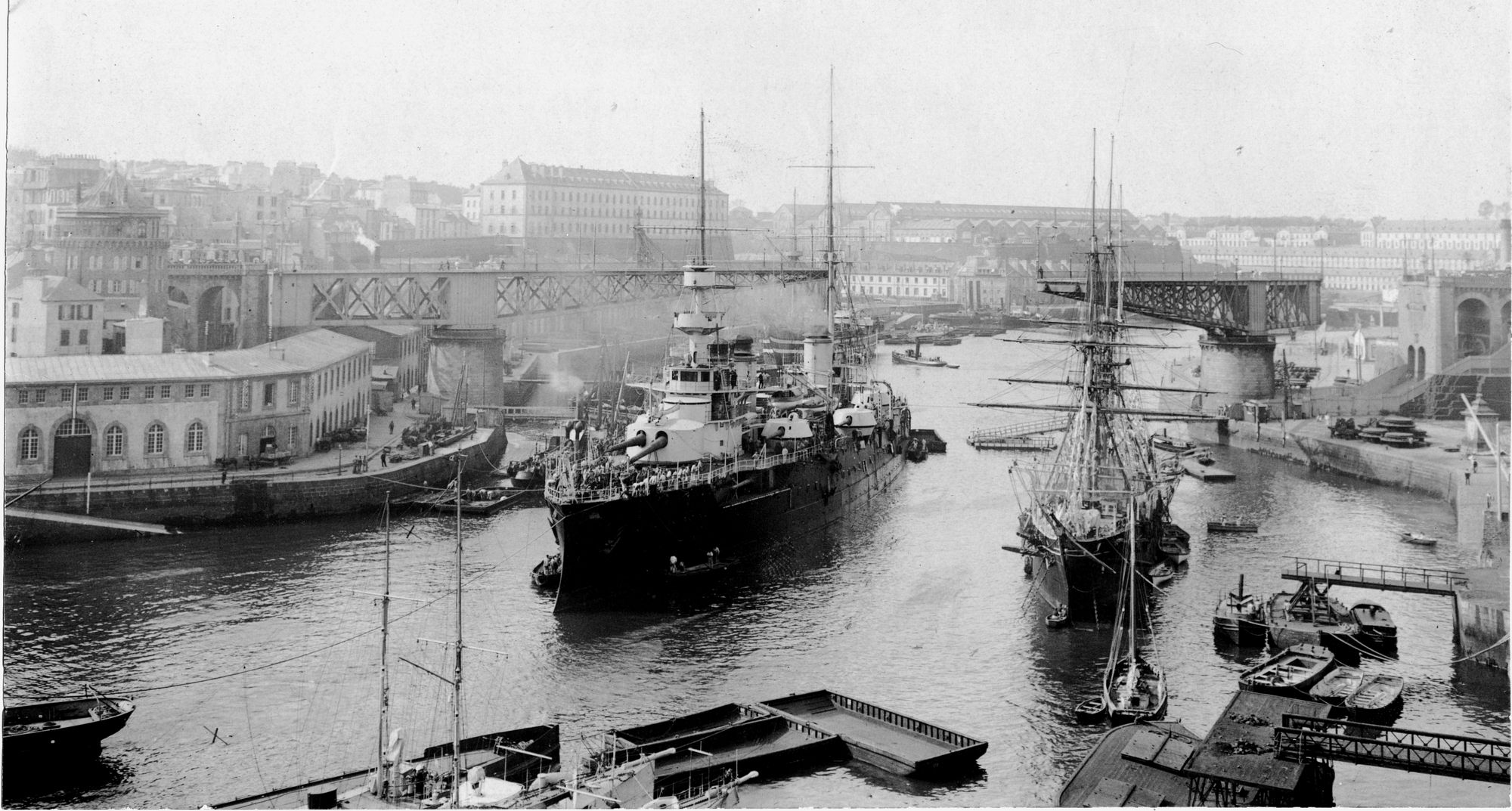
Catalogue number 29019 Democratie leaving Brest With an old sailing ship to port and another in the background, Democratie is towed out of the port. Note the line starboard bow to the dockside as an aide for navigating the channel. Verso:"Brest. The battleship "Democratie" leaving the Arsenal" in French and in heavy pencil 21.4cm x 13.5cm Albumen print |
 |
|
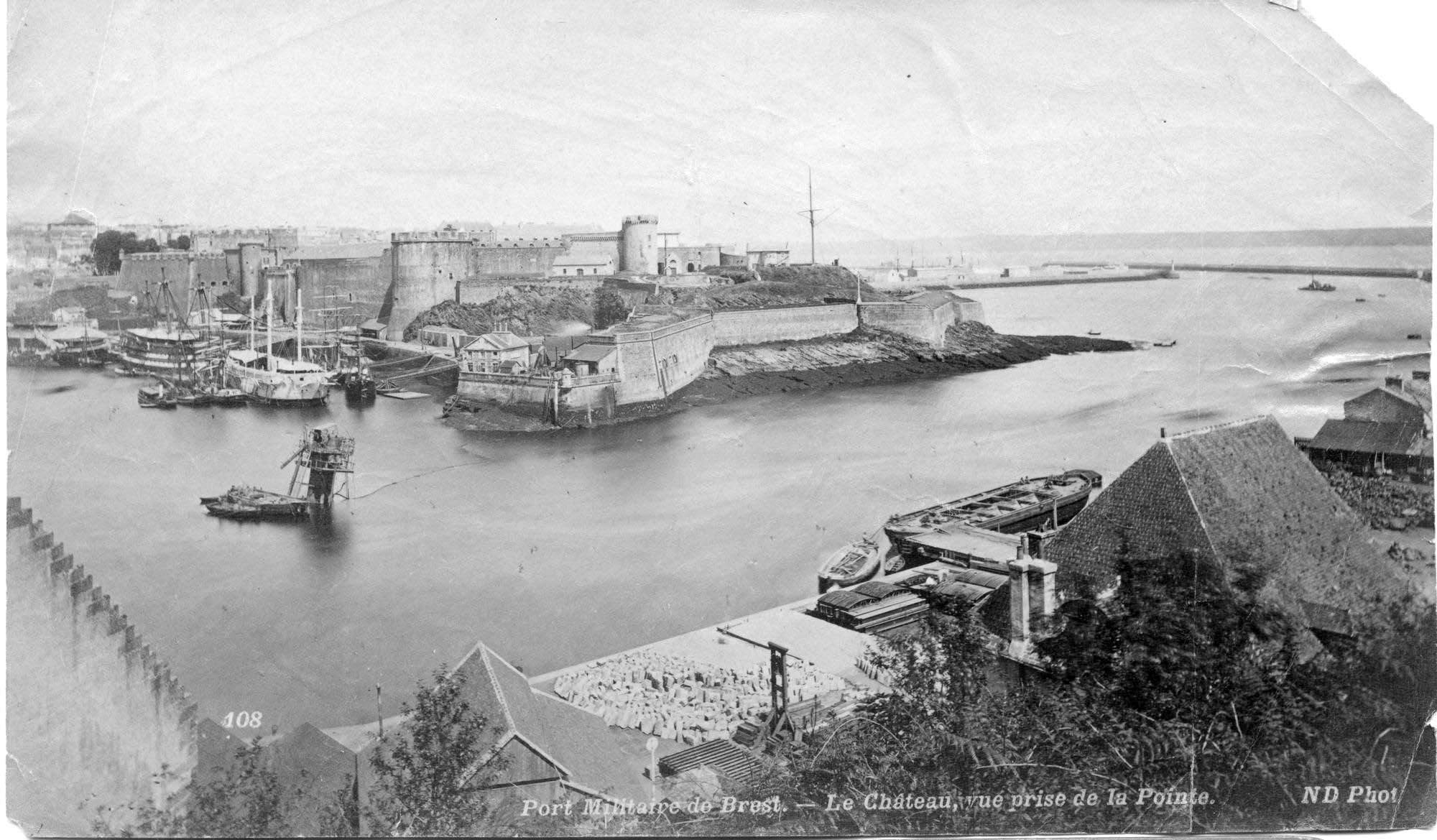
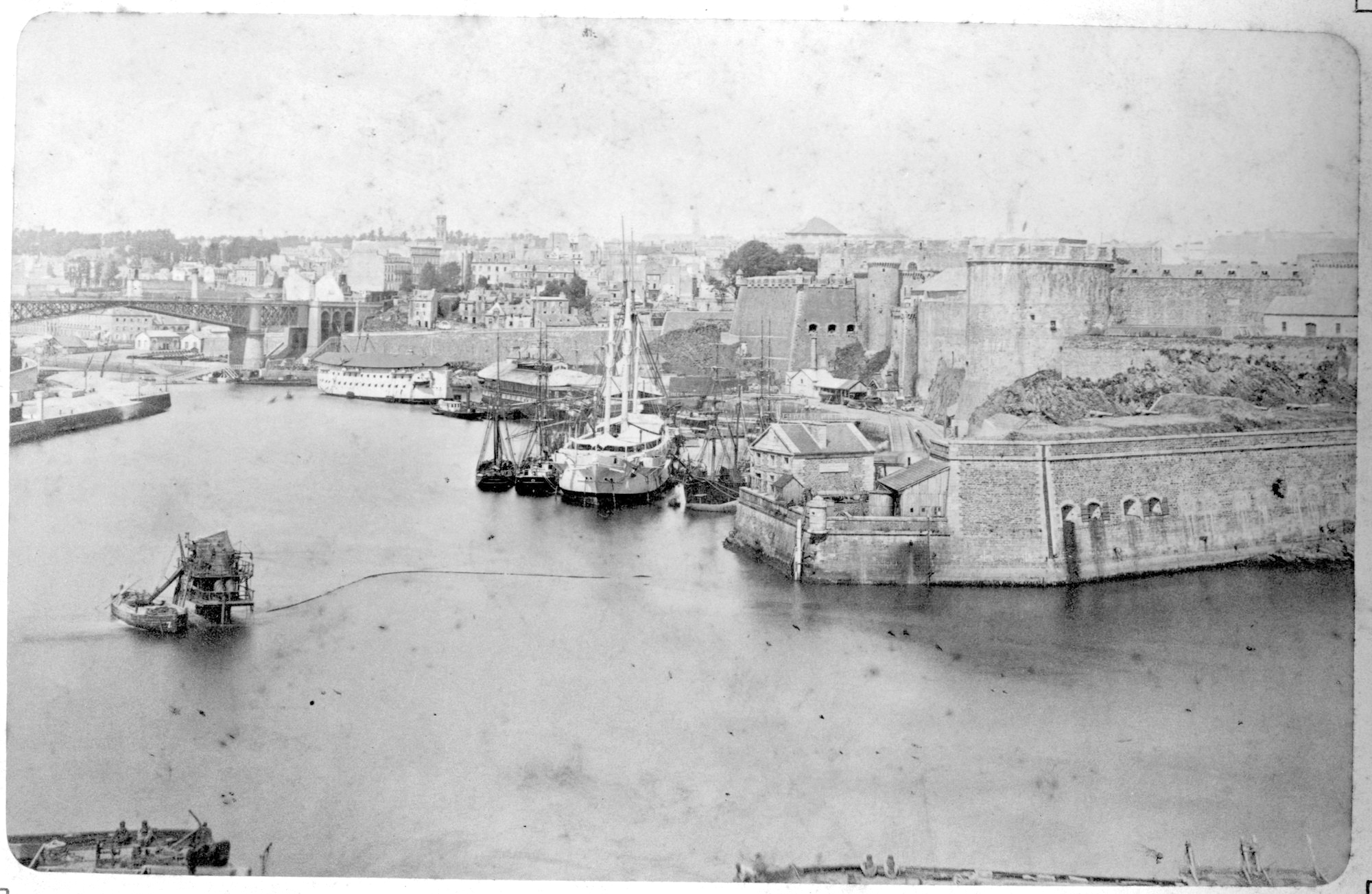
Catalogue number 28012 Work at the entrance to the port, low tide This photograph from the end of the 1800s shows the tower used to break-up the rock on the seabed at the entrance to the port. There were several high points on the seabed that were a risk to the passage of the newer warships with an ever-increasing draft. Recto:"Brest military port- the chateau seen from the point" in French 18.3cm x 11cm Albumen print |
 |
|
Catalogue number 82004 Breaking-up the rock on the seabed At high tide, the tower was almost completely submerged. The line running from the chateau to the tower is probably a compressed air line and the barge moored to the tower receives the rocks via a chute. We are not sure but it is probable the the tower sat on the seabed with some kind of watertight seal, the tower was pumped out and workmen went down into the tower to work pneumatic hammers. This photograph gives a good view of the hulked ships of the line. 15.6cm x 10.1cm Mounted albumen print |
 |
|
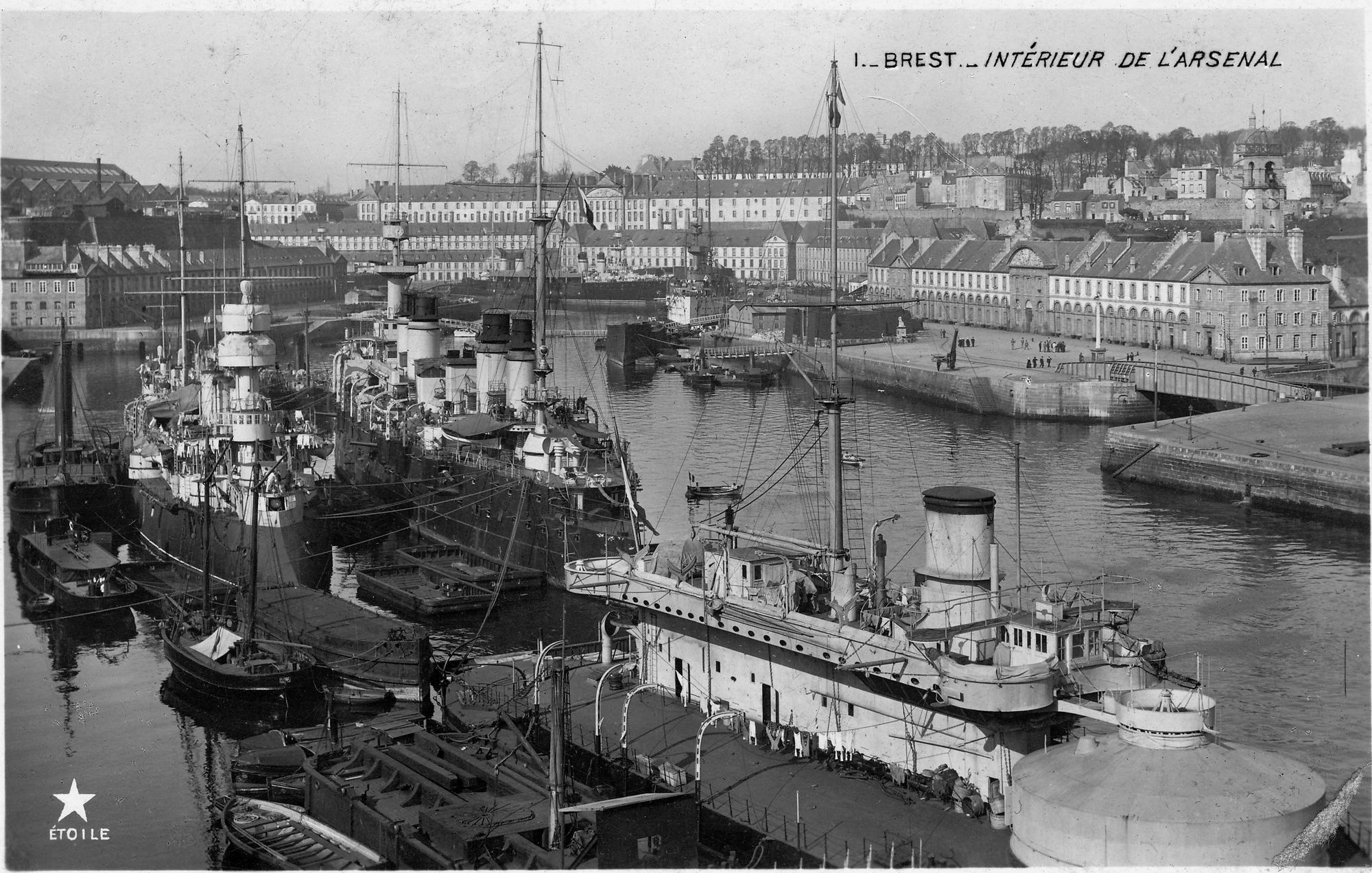
Catalogue number 35185 Warships in the Arsenal, 1907 Tempete class breastwork monitor (Tempete or Vengeur) Gloire class armoured cruiser (the Marseillaise was completed at Brest in 1903) with possibly a second Gloire class in the far background Dupuy de Lome, built in Brest, in 1905 the military mainmast was removed . 13.1cm x 8.2cm Gelatin silver print |
 |
| World War One and the Inter-war Years |
|
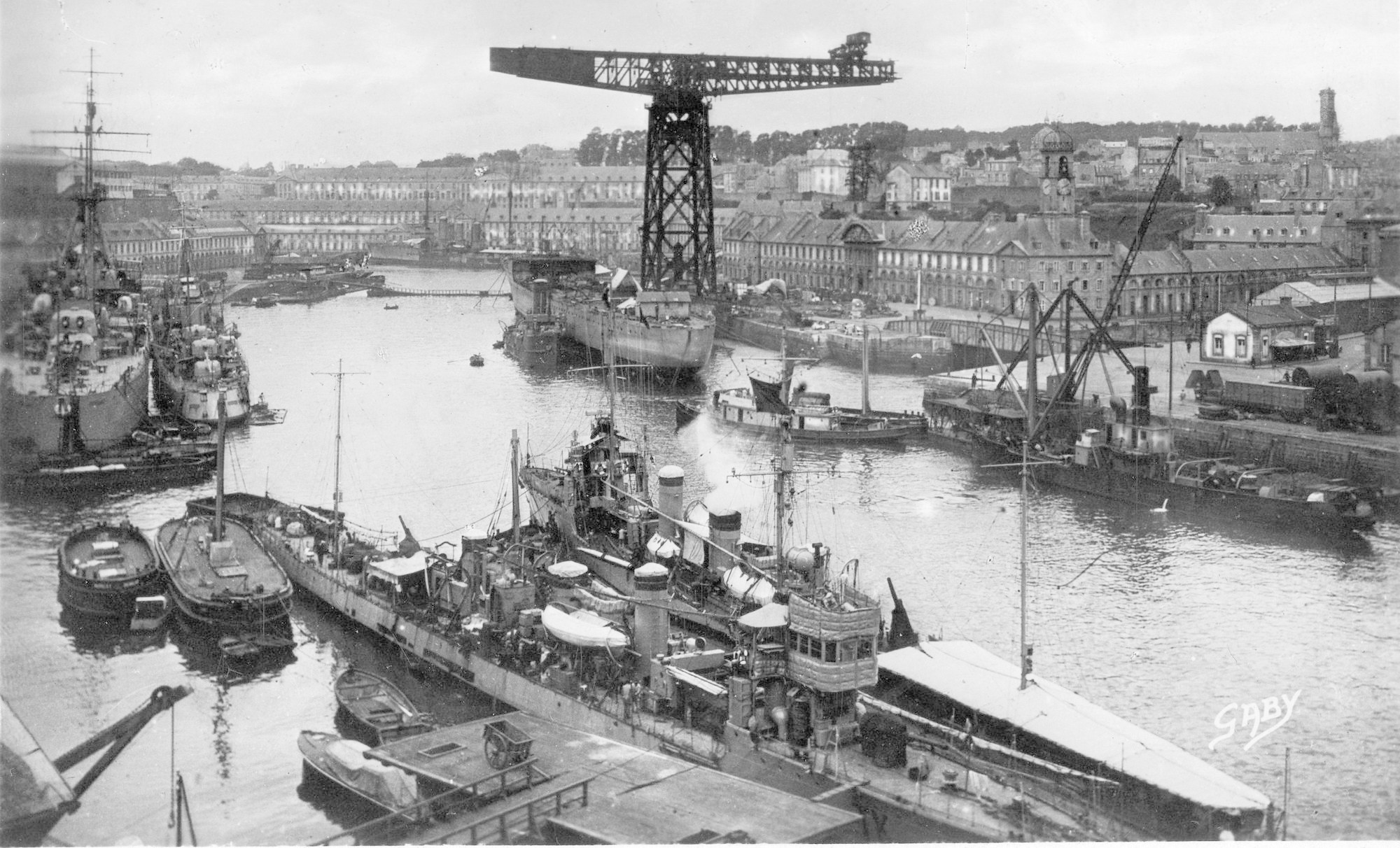
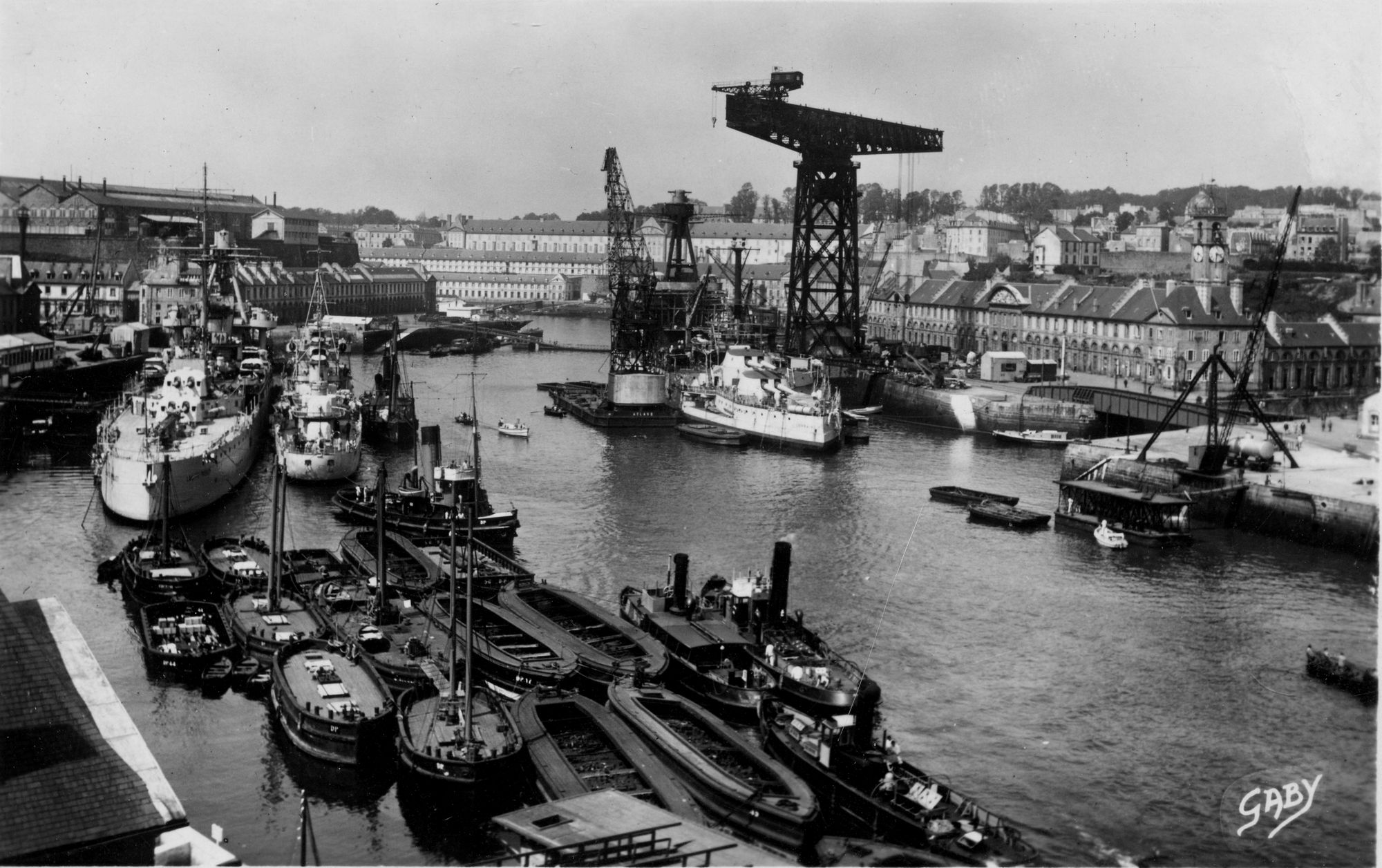
Catalogue number 104021 The Inter-war years The French destroyer Tonkinois (center foreground) was one of a series of destroyers built in Japan for the French Navy in 1917. A second destroyer of the same Arabe-class is moored alongside. Rearmement is underway and a cruiser is under construction by the hammer-head crane. A cruiser and a fast destroyer are to the left of the photograph. Credit: Gaby 13.3cm x 8.1cm Gelatin silver print |
 |
|
Catalogue number 40206 American Expeditionary Forces, Brest This photograph was taken sometime between 1917 and 1919, it shows American supposedly French destroyers off the naval port of Brest. These destroyers accompanied the Atlantic convoys from America bring food, weapons and troops to France. Given such a concentration of ships in the harbour, it may be that the war had come to an end. Verso:"Warships in Brest Harbor American and French Destroyers" Credit: U.S. Army Signal Corps 19.6cm x 14.5cm Gelatin silver print |
 |
|
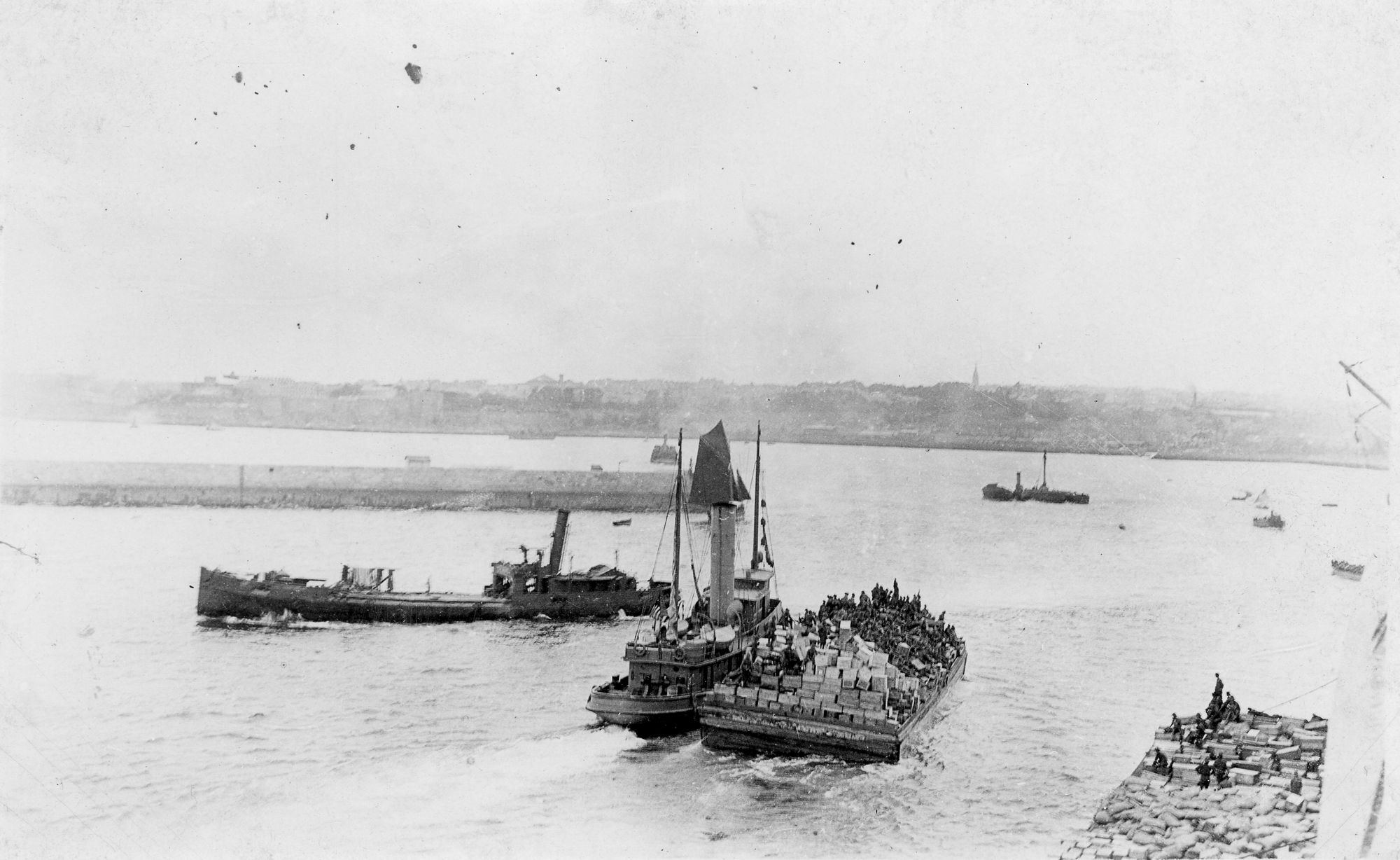
Catalogue number 122075 American soldiers and stores coming ashore at Brest, 1917-1918 An American tug is taking a loaded barge into the harbour of Brest. Note stores to the stern of the barge and soldiers forward. A second barge loaded with stored is to the bottom right. Verso:"Convoying soldiers at Brest." in fine black ink 13.2cm x 8.2cm Gelatin silver print |
 |
|
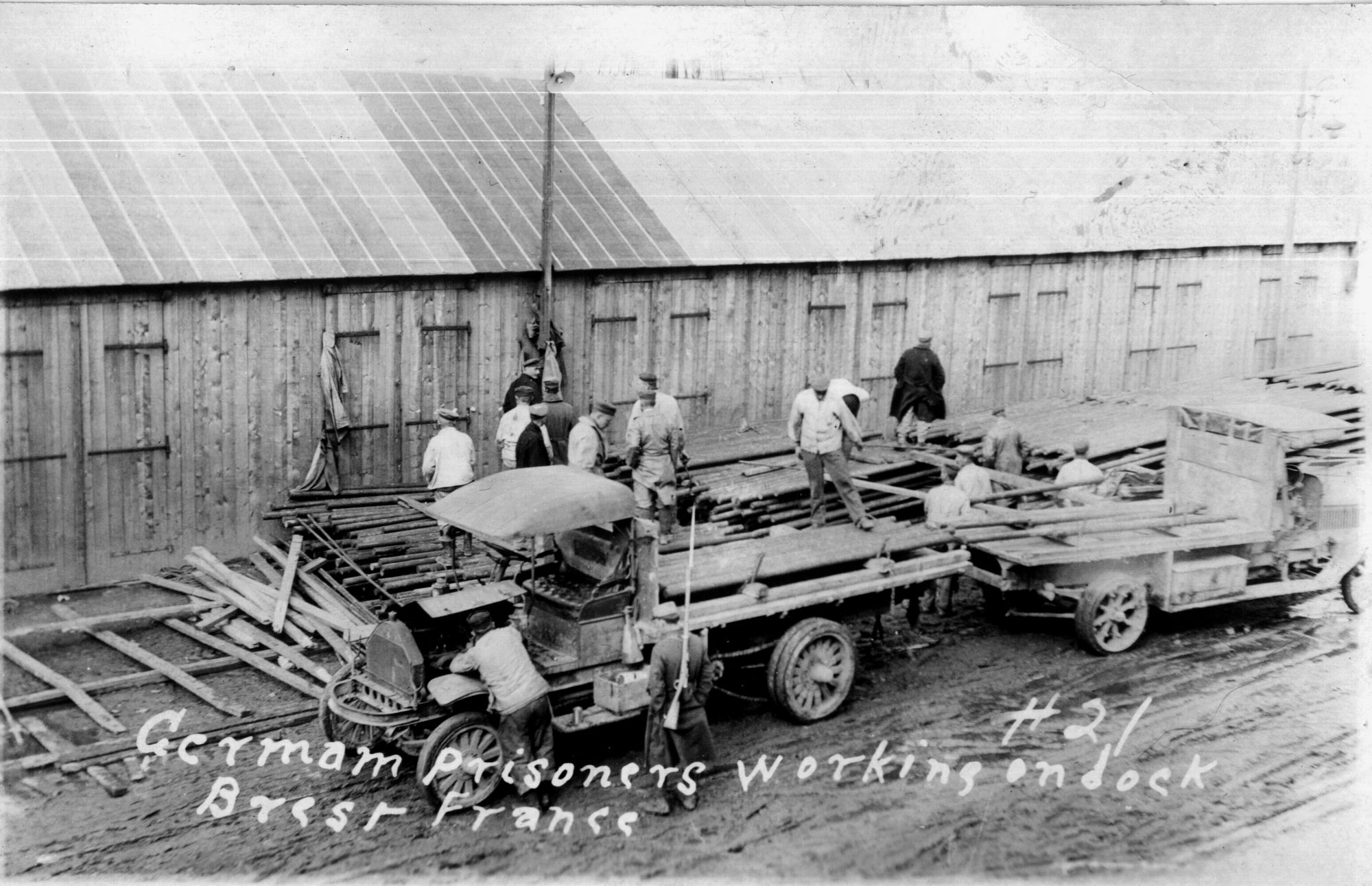
Catalogue number 79028 German prisoners working on the dock, Brest This photograph from World War One, is part of a series taken by a American photographer in Brest. He also took photographs of American troopships (in Brest, St Nazaire and Bordeaux) getting ready to take the American soldiers back home so we may assume that he was active after the end of the war. German prisoners are loading props onto a lorry and trailer whilst the French guard with a deadly-looking bayonet looks on and the lorry driver works on his engine. 13.1cm x 7.7cm Gelatin silver print |
 |
|
Catalogue number 15023 Modernization of the Lorraine in Brest Commissioned in 1916, the battleship Lorraine spent the duration of World War One in the Mediterranean Sea. During the 1934 to 1935 modernization in Brest, the center 340mm turret was removed and replaced with a hangar for seaplanes (initially Gourdou-Leseurre GL819 and Potez 452 replaced with Loire 130 flying boats) and a catapult. A heavy lift floating crane is alongside the ship and scafolding is built-up around the center turret placement.. 13.4cm x 8.4cm Gelatin silver print |
 |
|
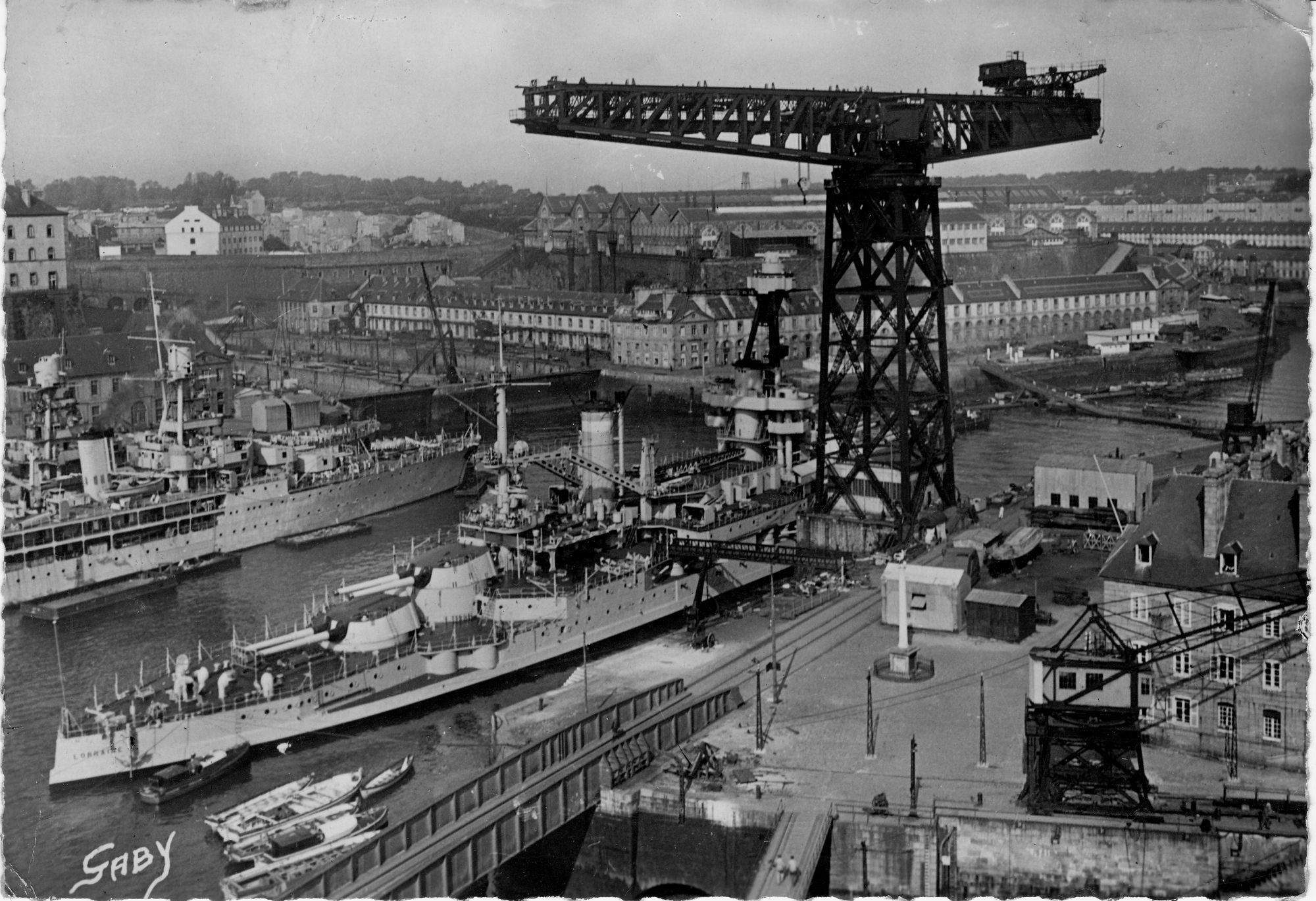
Catalogue number 35209 Battleship Lorraine with catapult The fourth refit is finished and we can see the catapult in place of the center turret. Where is the hangar, beneath the catapult and how are the seaplanes brought out onto the catapult? 14.8cm x 10.3cm Gelatin silver print |
 |
| Post World War Two |
|
Catalogue number 25001 Bombed out hospital Allied bombing caused much destruction in the naval base as well as in the town itself. It was said by the Allies that the Germans were using the hospital building for military use to justify the bombing. Heavy bombs have caused part of the land around the hospital to cave in. 12.2cm x 8cm Matt gelatin silver print |
 |
|
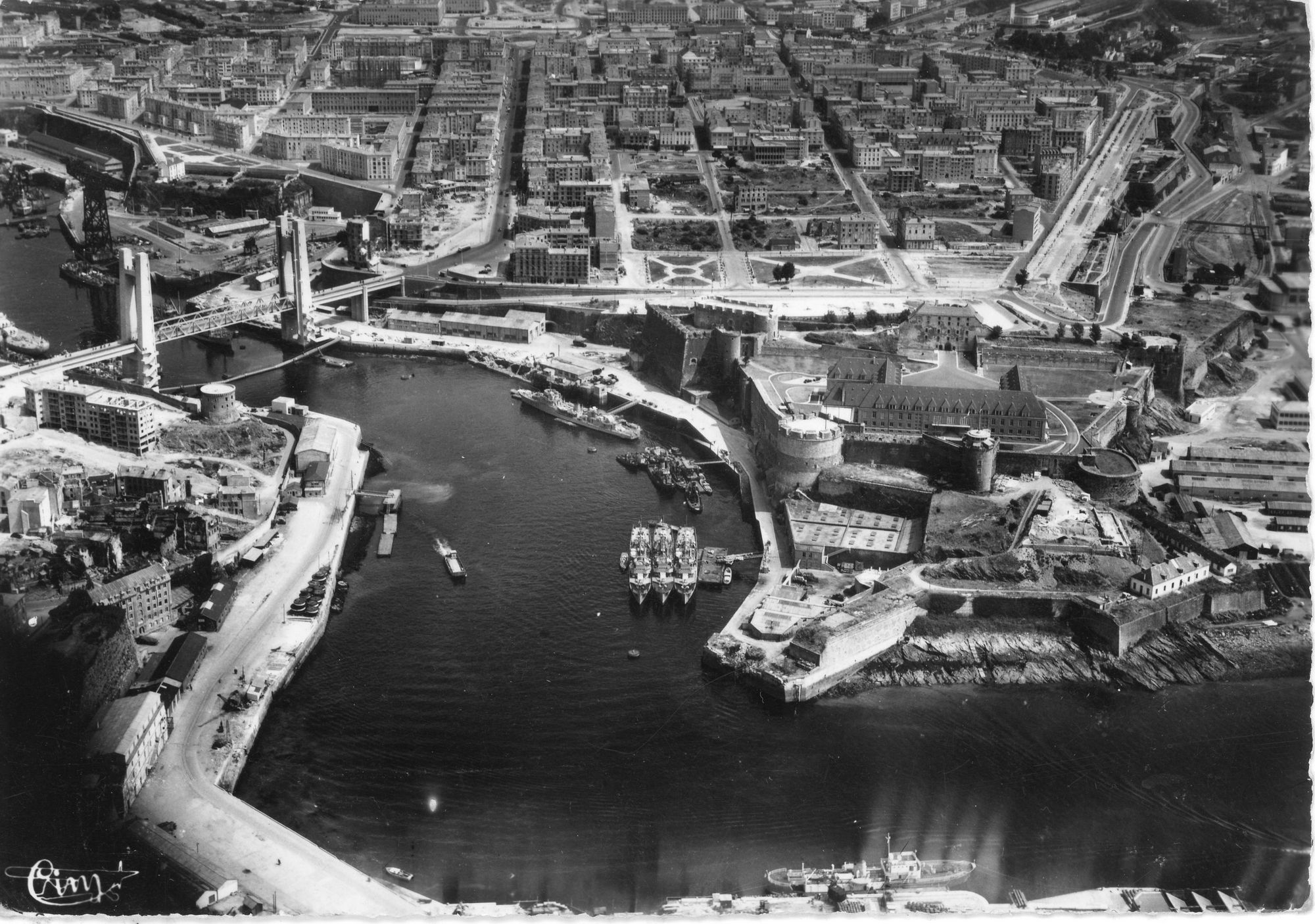
Catalogue number 128021 War damaged port and town, 1958 Much of the port has been reconstructed whilst the surrounding town area is undergoing rebuilding of apartment blocks. The new Pont de Recouvrance is in place. Verso:"Postcard franked 1958" 14.8cm x 10.4cm Gelatin silver print |
 |
|
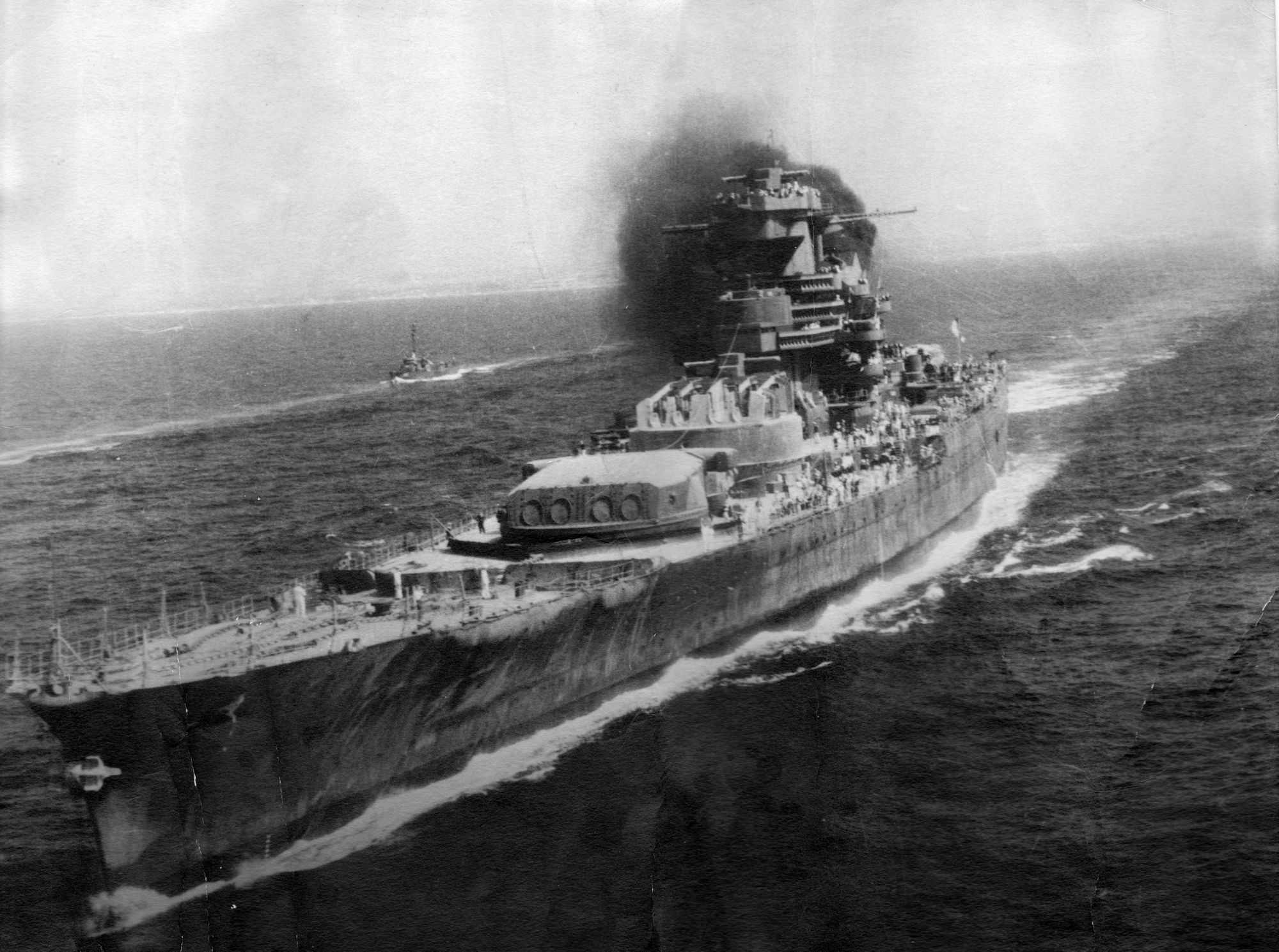
Catalogue number 88 The Jean Bart returning to France With its boilers and machinery in place but only part of its main and secondary armement was available and fitted, the battleship Jean Bart left St Nazaire in urgence to avoid being seized by the Germans and steamed to Casablanca. In 1945, the ship returned to France and was drydocked in Cherbourg and then moved to Brest once the drydock was functional. This photograph shows the Jean Bart steaming to Cherbourg, note the absence of guns (they had been removed and fitted to the Richelieu during its refit in the U.S.A.)and the unfinished B turret. Credit: Service Cinéma des Armées 40cm x 30cm Matt gelatin silver print |
 |
|
Catalogue number 25001 Drydocks 8 and 9, 1948 Allied bombing and a meticulous demolition by the departing German forces left the naval port in a very poor state. Reconstruction of the drydocks 8 and 9 began in June 1946 with an outer seawall built around the entrance to the two docks was constructed from June 1947 to November 1947. Floating caissons that could be flooded formed a gate to open and close the outer wall and dry dock 9 had a lockgate in place. Quite an engineering feat considering the post-war scarcity of materials for construction and the devastation in Brest. The partially completed battleship Jean Bart was docked in March 1948. An unidentified cruiser is in drydock 8. 22cm x 16.2cm Gelatin silver print |
 |
|
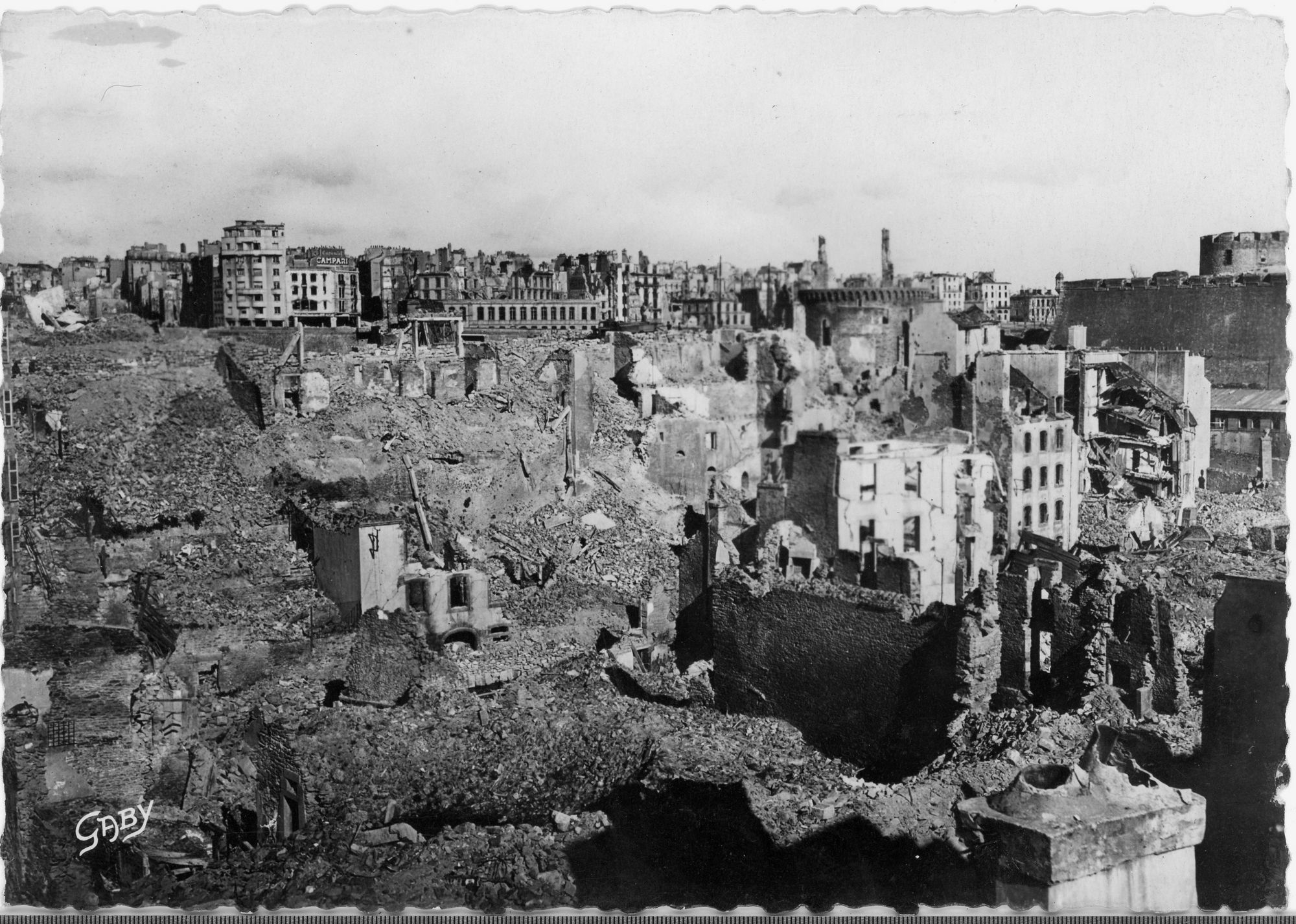
Catalogue number 157035 Brest, destruction after the Allied bombardement, 1944 The zone in and around the dockyard was the target of numerous Allied bombardements, reducing houses, dockyard infrastructure and the quays to rubble. Credit: Gaby 15cm x 10.4cm Gelatin silver print |
 |
|
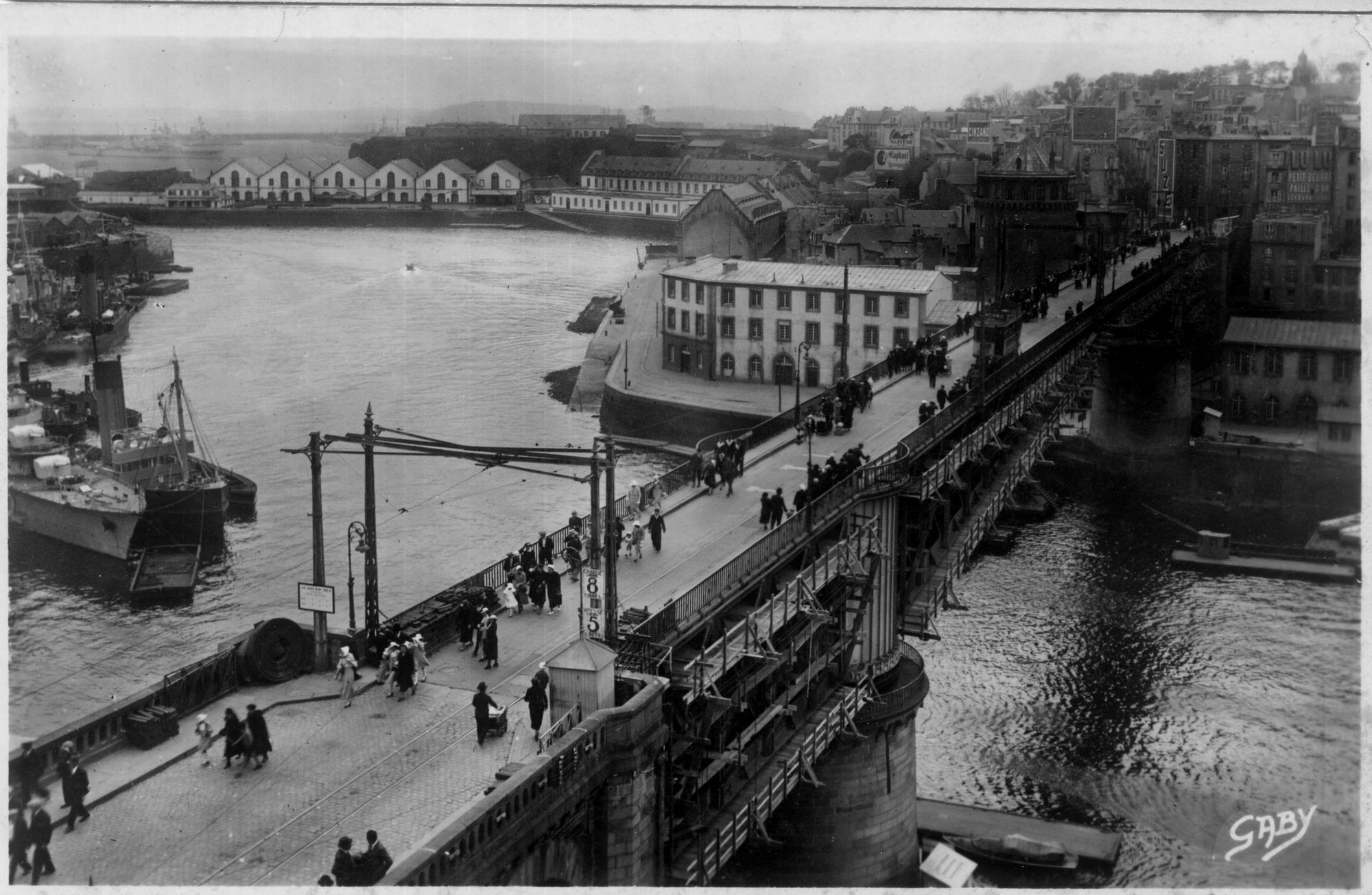
Catalogue number 44052 Brest, the Pont National, pre-war The Pont National was a busy thoroughfare linking the district of Recouvrance and the city center prior to its destruction, note the single track tramway and maintenance work underway on the metal bridge structure, the postcard is dated 1937 Credit: Gaby 13.4cm x 8.4cm Gelatin silver print |
 |
|
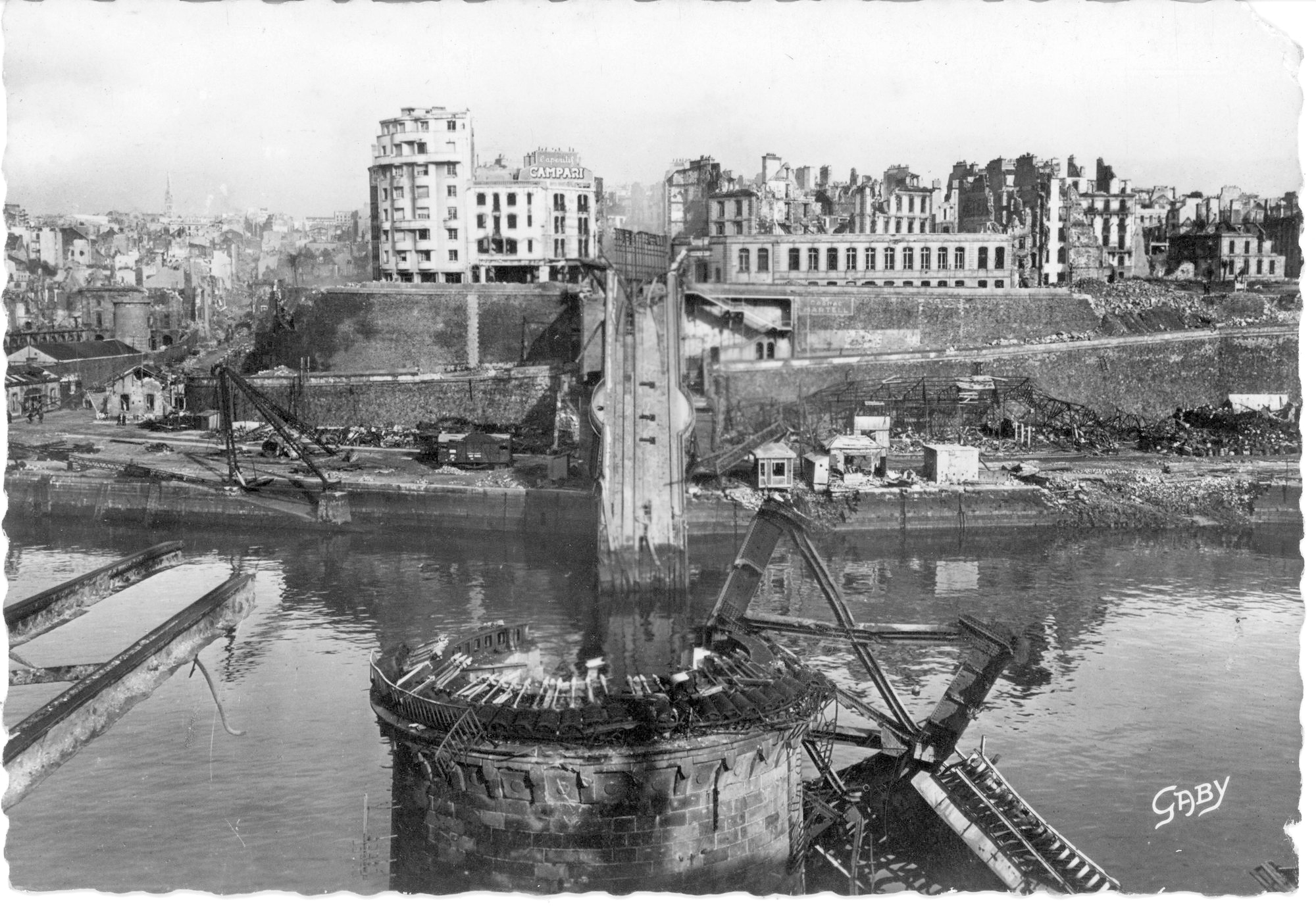
Catalogue number 157034 Brest, destruction of the Pont National Destroyed by Allied bombing and further demolished by the retreating German forces, the pont Nationale was replaced by the vertical lift bridge, the Pont de Recouvrance. Credit: Gaby 15cm x 10.5cm Gelatin silver print |
 |
|
Catalogue number 68003 The demolished Pont Nationale at the liberation of Brest Not only is the bridge rendered useless, note the destruction of the dockside buildings and the devastation in the town itself. Verso:"New York Bureau. Shattered Brest Bridge. Brest, France -- Broken in two, with each half tilting into the water, the Joan of Arc bridge (sic) at Brest was hopelessly wrecked when the vital French city fell to the Allies. 10/9/44" and "Nov 22 1944" as red rubber stamp. 21.4cm x 16cm Gelatin silver print |
 |
|
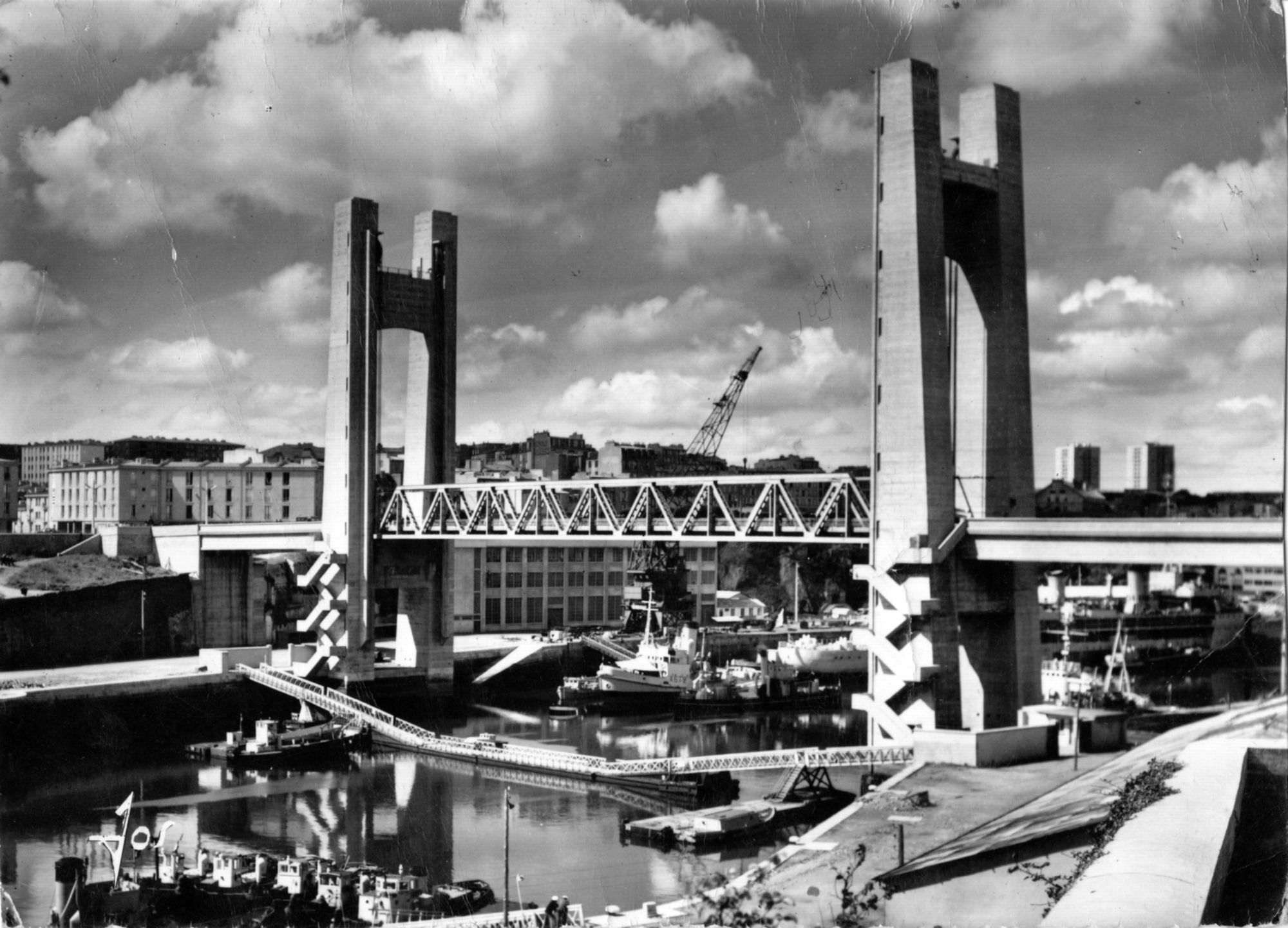
Catalogue number 43006 Pont de Recouvrance In 1954, a new vertical lift bridge was opened replacing the destroyed Pont National swing bridge. Note the pulley system at the top of the left-hand tower. Verso:"Brest (Finistere) Pont de Recouvrance on the Penfield with a span of 88 metres" in French 14.5cm x 10.5cm Gelatin silver print |
 |
|
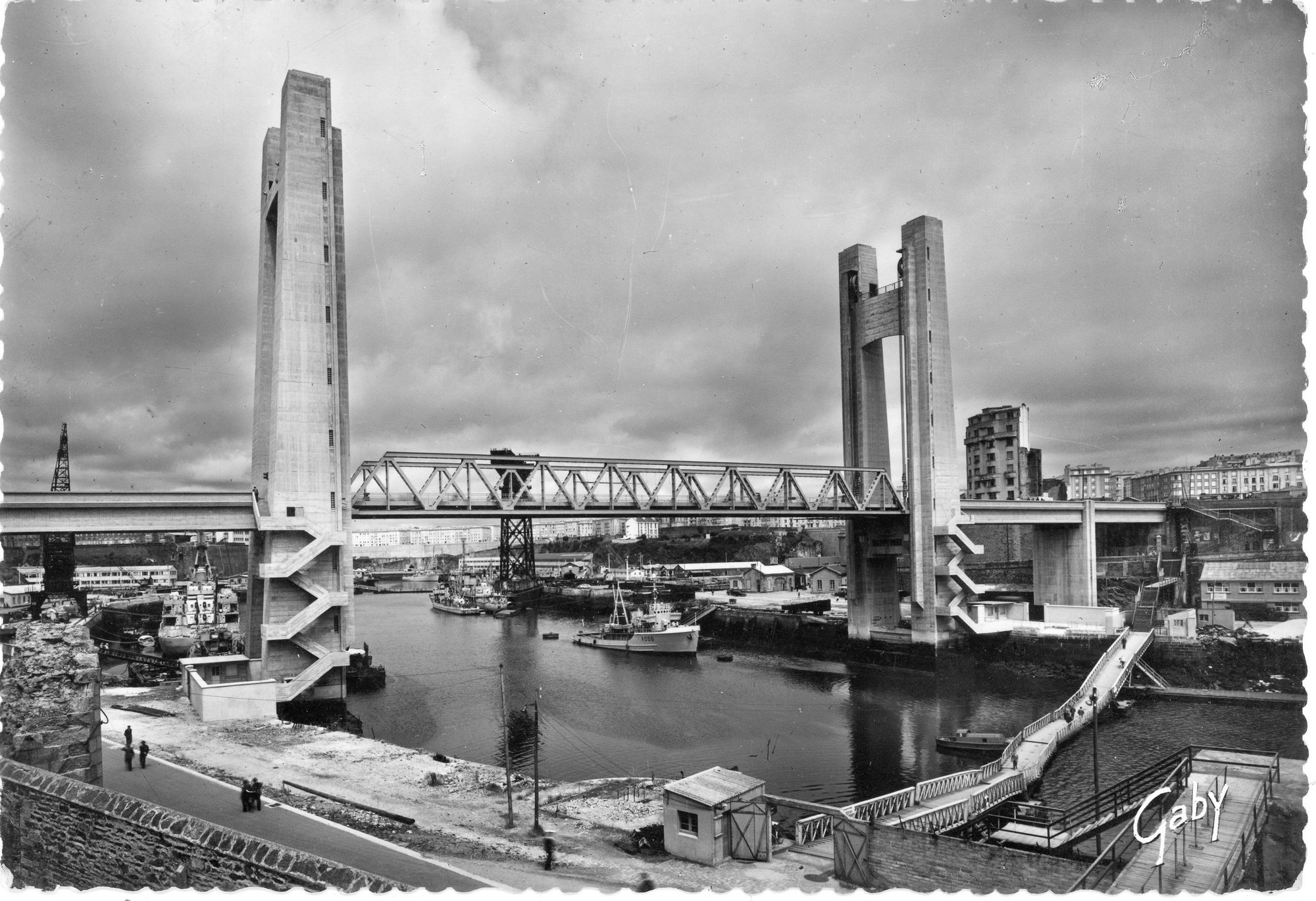
Catalogue number 155083 Pont de Recouvrance, postcard 1955 Note the staircase from the quay to the bridge platform, the pulleys at the top of the right-hand tower with cables running down to the bridge span and the pontoon footbridge spanning the river. The quayside still has traces of war-damage. Verso:"Brest (Finistere) Pont de Recouvrance on the Penfield" in French and franked 1955 15cm x 10.2cm Gelatin silver print |
 |
|
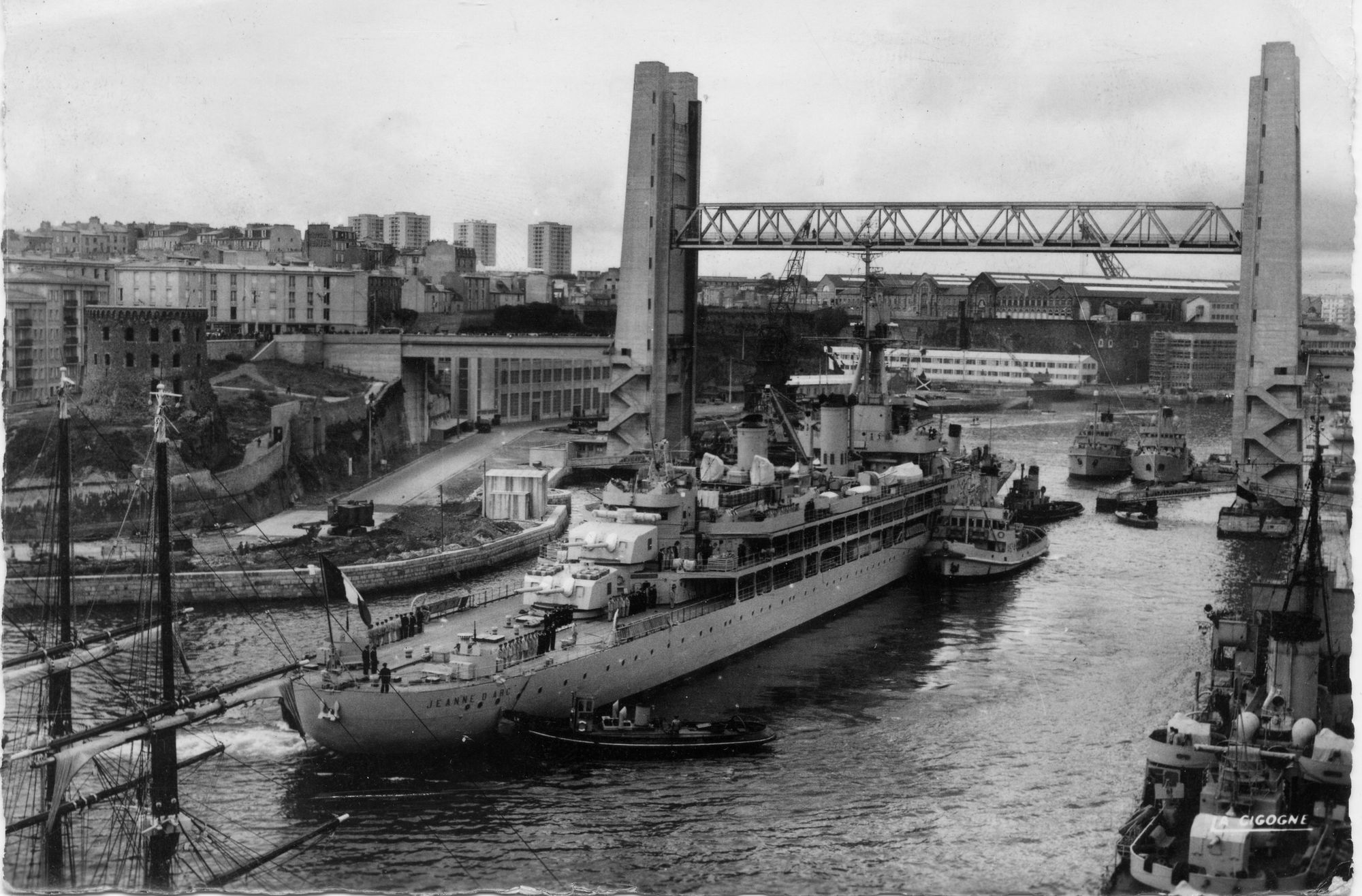
Catalogue number 27035 The Pont de Recouvrance in the raised position The bridge is raised to let the training ship Jeanne d'Arc go through. A system of pulleys and counterweights move the bridge up and down. Verso: Postcard franked 1964 14.8cm x 10.3cm Gelatin silver print |
 |
|
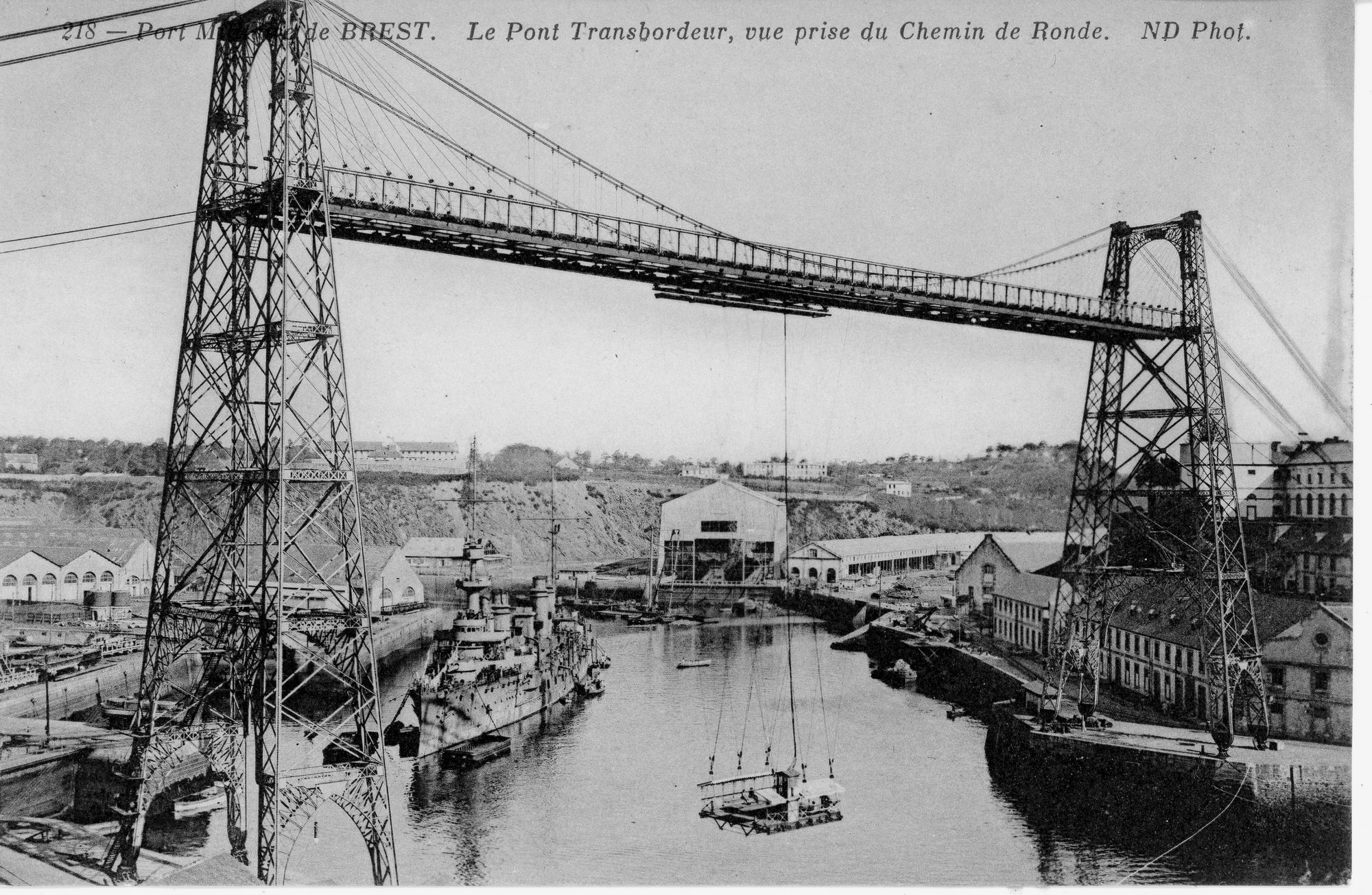
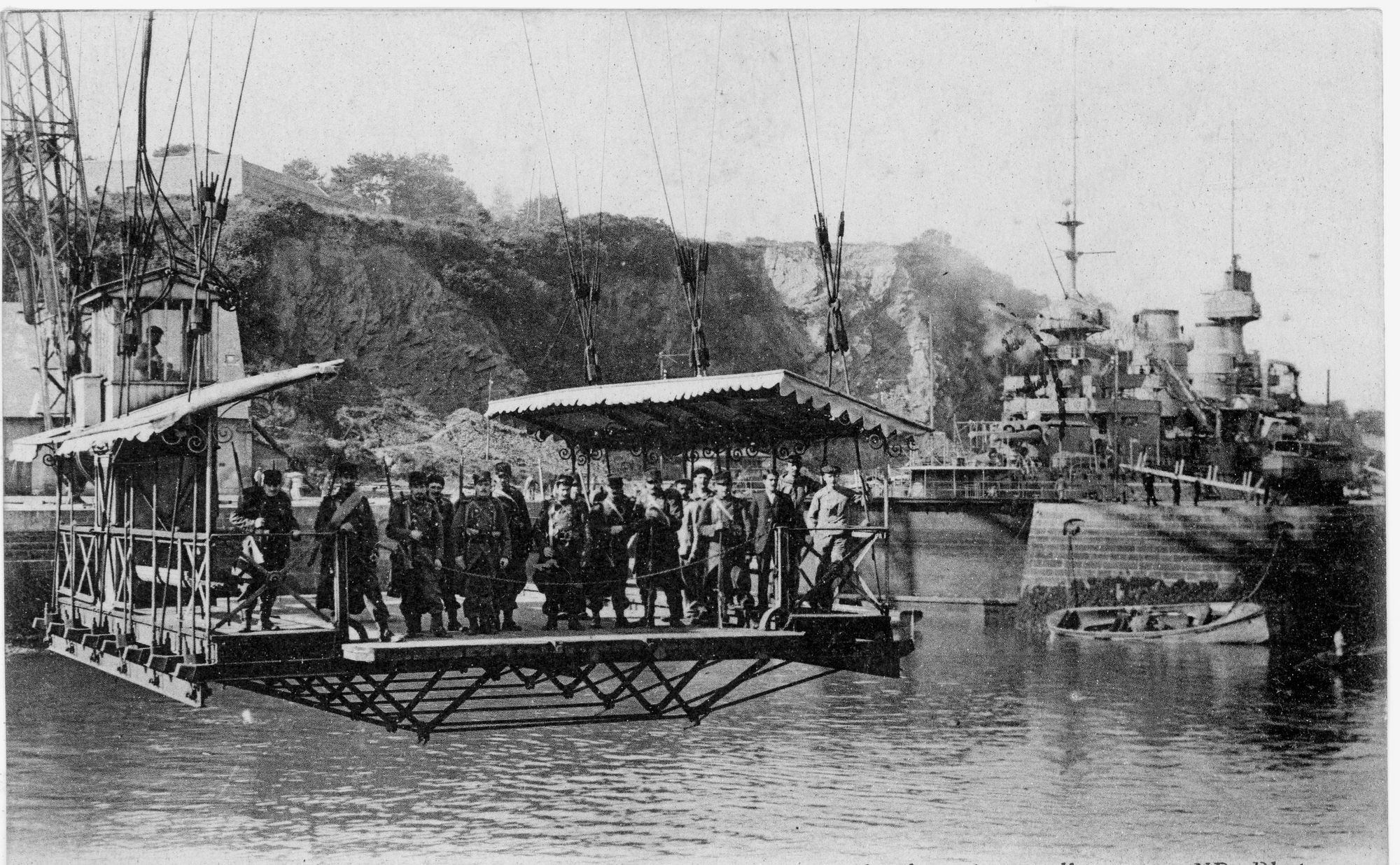
Catalogue number 157061 Nacelle and the Pointe-du-Jour drydock A transporter bridge was placed across the Penfeld channel in 1909. Originally in place at Bizerte, Tunisia, the bridge was dismantled and reconstructed in Brest. The nacelle was suspended at a height so as to be level with the dockside, in the background is the covered drydock Point-du-Jour. 13.8cm x 9cm Printed image |
 |
|
Catalogue number 157059 Nacelle of the transporter bridge A platform nacelle was suspended from a moving carriage on rails up on the span, transporting men and light materials from either side of the channel. Note the control cabin to the left and the electric control cables running up to the carriage. The pylons were held-up by cables anchored to concrete blocks set in the cliffside. A pole-masted battleship is in the drydock number 4. 13.8cm x 9m Printed image |
 |
|
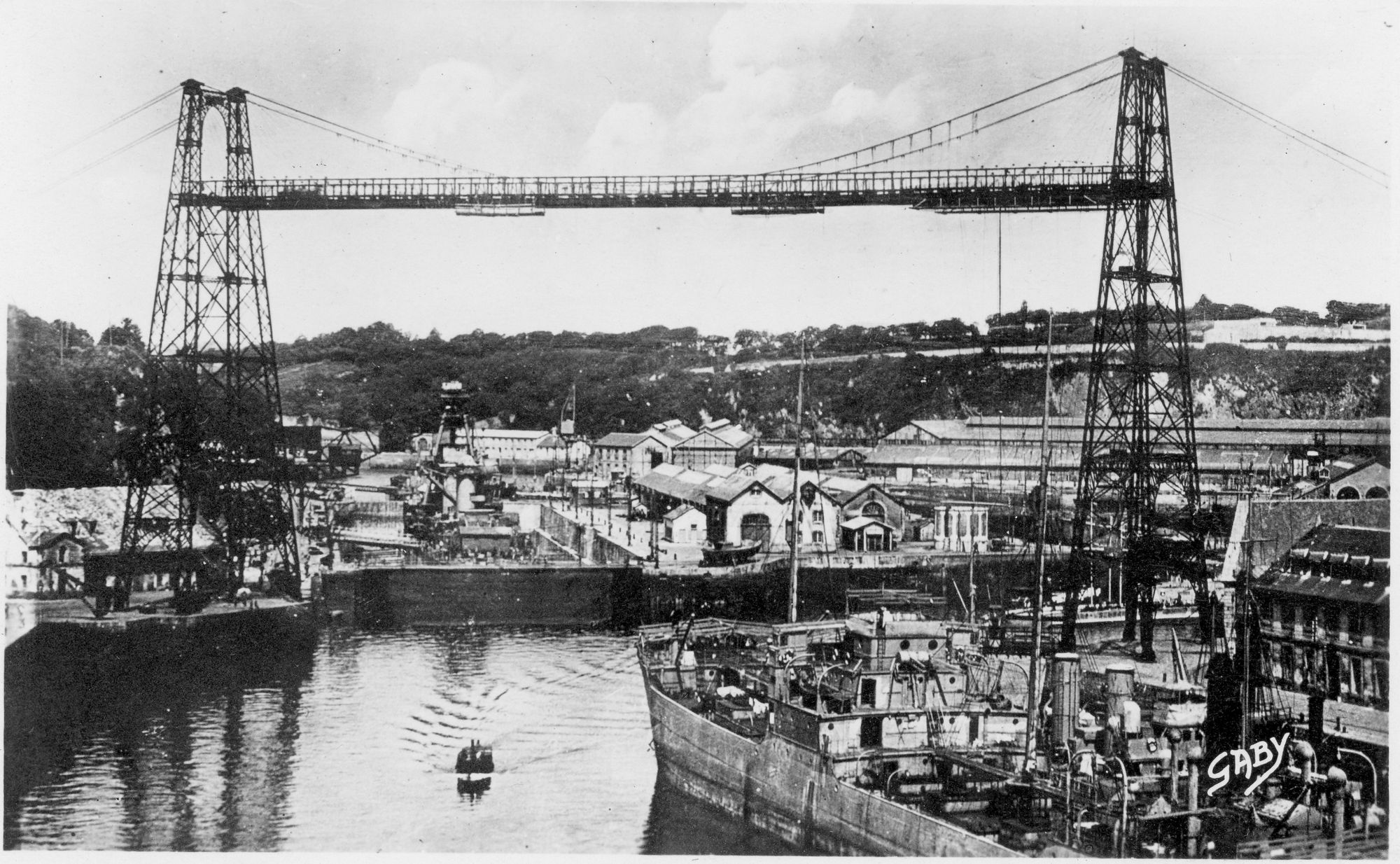
Catalogue number 157062 Transporter bridge and drydock 4 A Bretagne class battleship with its tripode mast is in the drydock number four and we can see a submarine in the channel towards the drydock Point-du Jour. Credit:Gaby 13.2cm x 8.1cm Gelatin silver print |
 |
|
Catalogue number 155085 Pont de l'Harteloire The old transporter bridge was damaged beyond repair during the war and was replaced by the Pont de l'Harteloire in 1951. With a total length of 581 metres and a main span of 97 metres, the bridge has two lanes for traffic and a pedestrian footpath. Note the war-damage to the quayside and the repaired drydock in the background. Verso:" Brest (Finistere) Pont de l'Harteloire 14.9cm x 10.5cm Gelatin silver print |
 |
|
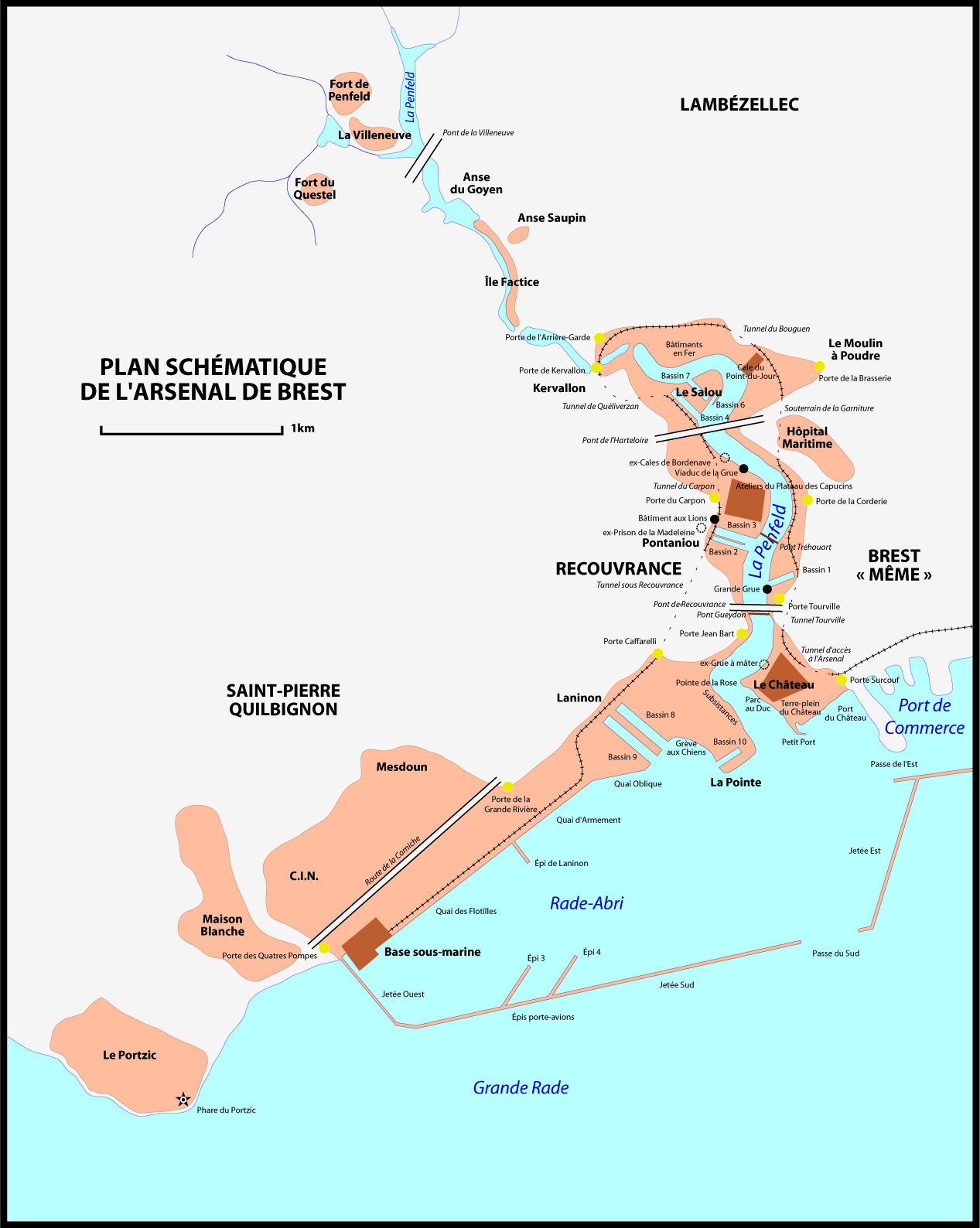
Catalogue number Plan of the Arsenal at Brest This plan shows the present-day arrangement of the dock facilities in the naval port of Brest. Credit: Content subject to the CC-BY-SA 4.0 license. Source : Article Arsenal de Brest from Wikipedia in French |
 |
|
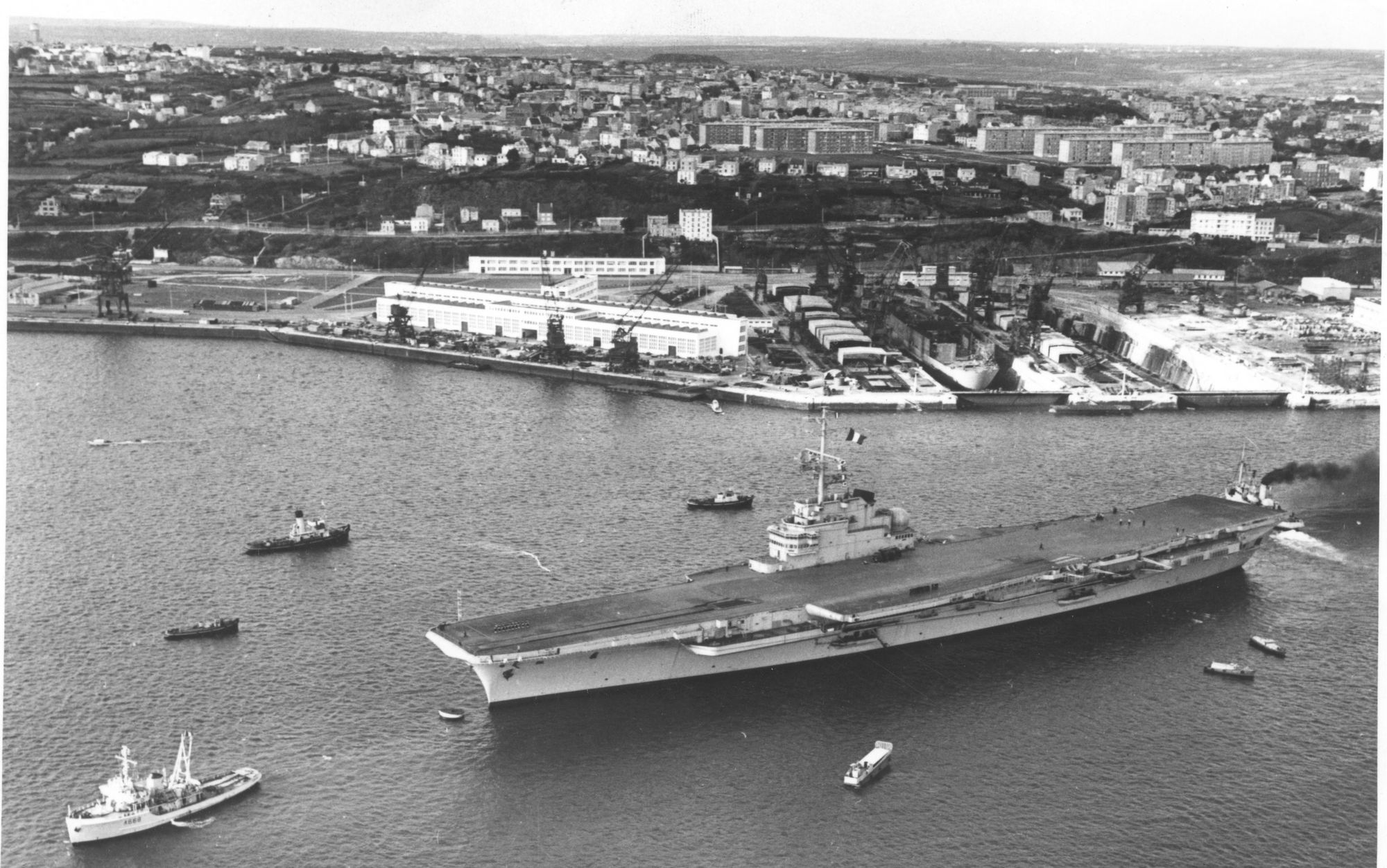
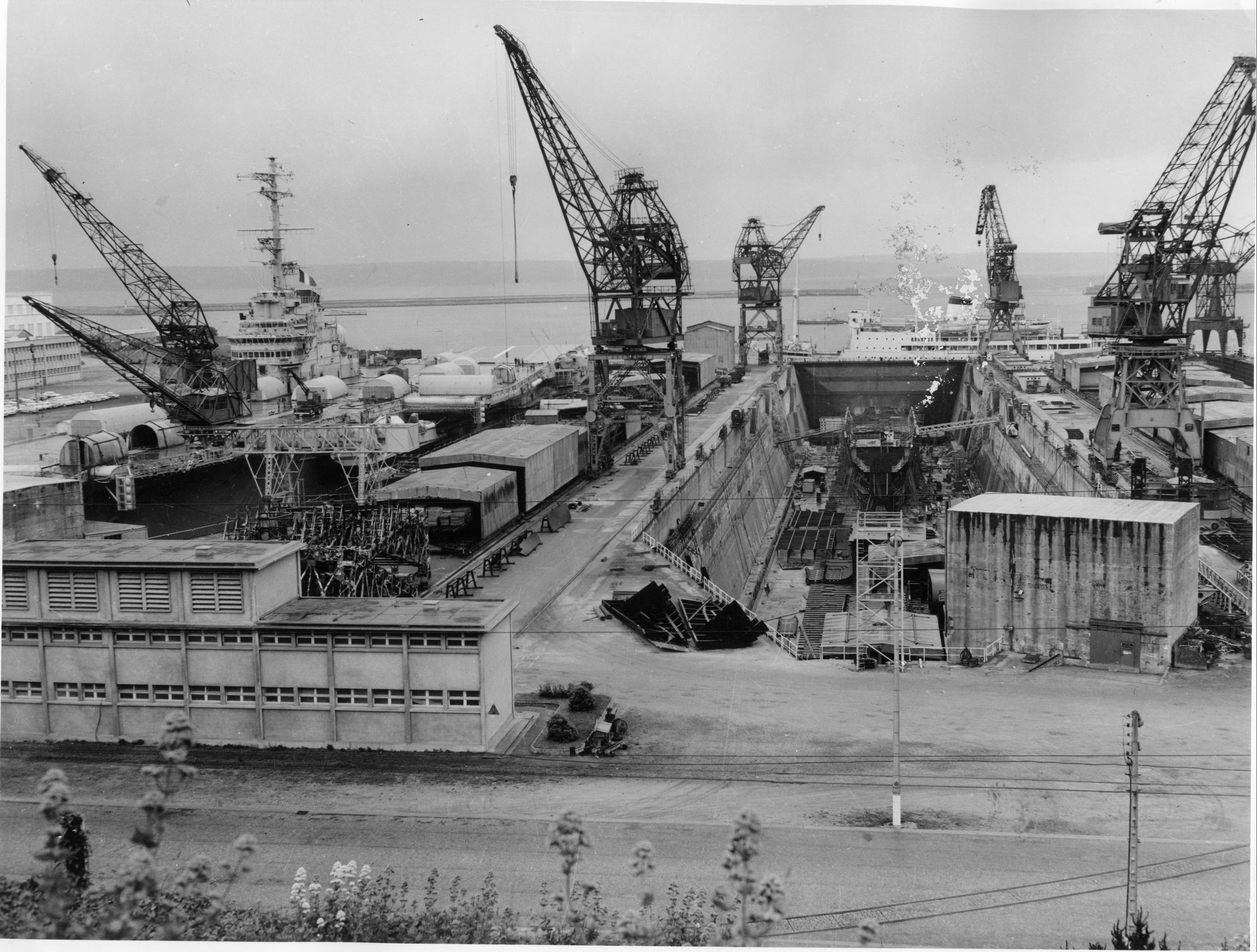
Catalogue number 29029 Clemenceau, 1959 Tugs manoeuvre the unfinished carrier in the port of Brest, note the absence of gun turrets and the cruiser Jeanne d'Arc under construction in the drydock 9. Credit: Service Cinema des Armées 17.3cm x 12cm Gelatin silver print |
 |
|
Catalogue number 25039 Drydocks 8 and 9 repaired This may be a photograph of the aircraft carrier Clemenceau during a refit in the drydock 8 in Brest. The gun turrets seen here were not in place when the carrier was launched (see catalogue number 29029). Note a ship under construction in the drydock 9. 23cm x 17.3cm Gelatin silver print |
 |
|
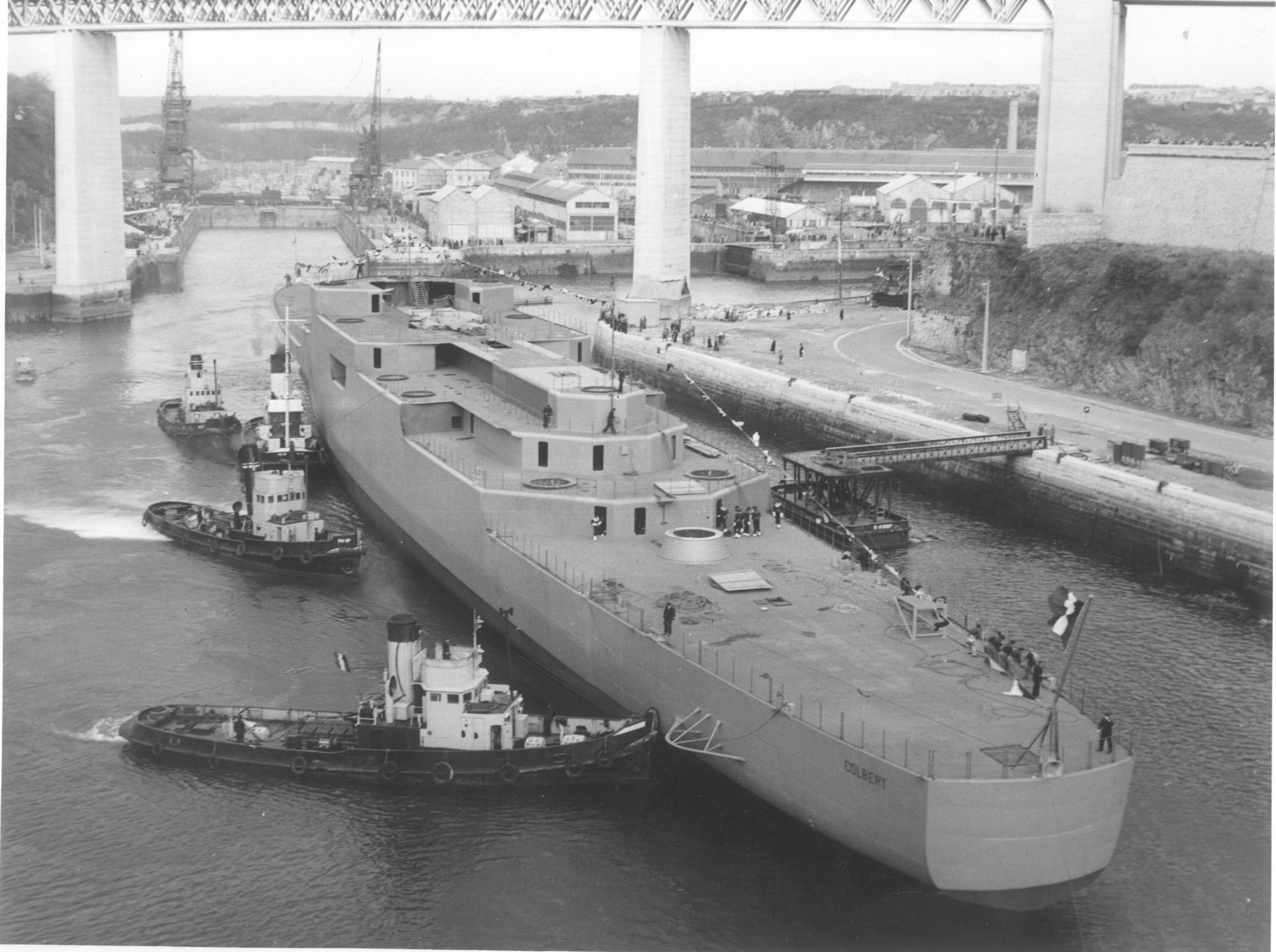
Catalogue number 71029 The cruiser Colbert after launching, 1956 It looks like Colbert was floated out of the drydock 4, the post-war reconstruction of the Marine Nationale was in full swing. Verso:"Hull of Colbert leaving the drydock 4 at Salou, Arsenal of Brest" in French and in light pencil Credit: Service Cinema des Armees 23cm x 17.3cm Gelatin silver print |
 |
|
Catalogue number 88 The roadstead, Brest Colbert, fleet escort Jaureguiberry (D637) and part of a second fleet escort (bottom left of center) plus Clemenceau at the fitting-out bay and the aviso Commandant de Pimodan (F739) with the stern of another aviso midground right. 39cm x 29cm Gelatin silver print |
 |
|
Catalogue number 88 Another view of the roadstead As for catalogue number 88 plus the battleship Richelieu behind the Clemenceau. cm x cm Gelatin silver print |
 |
|
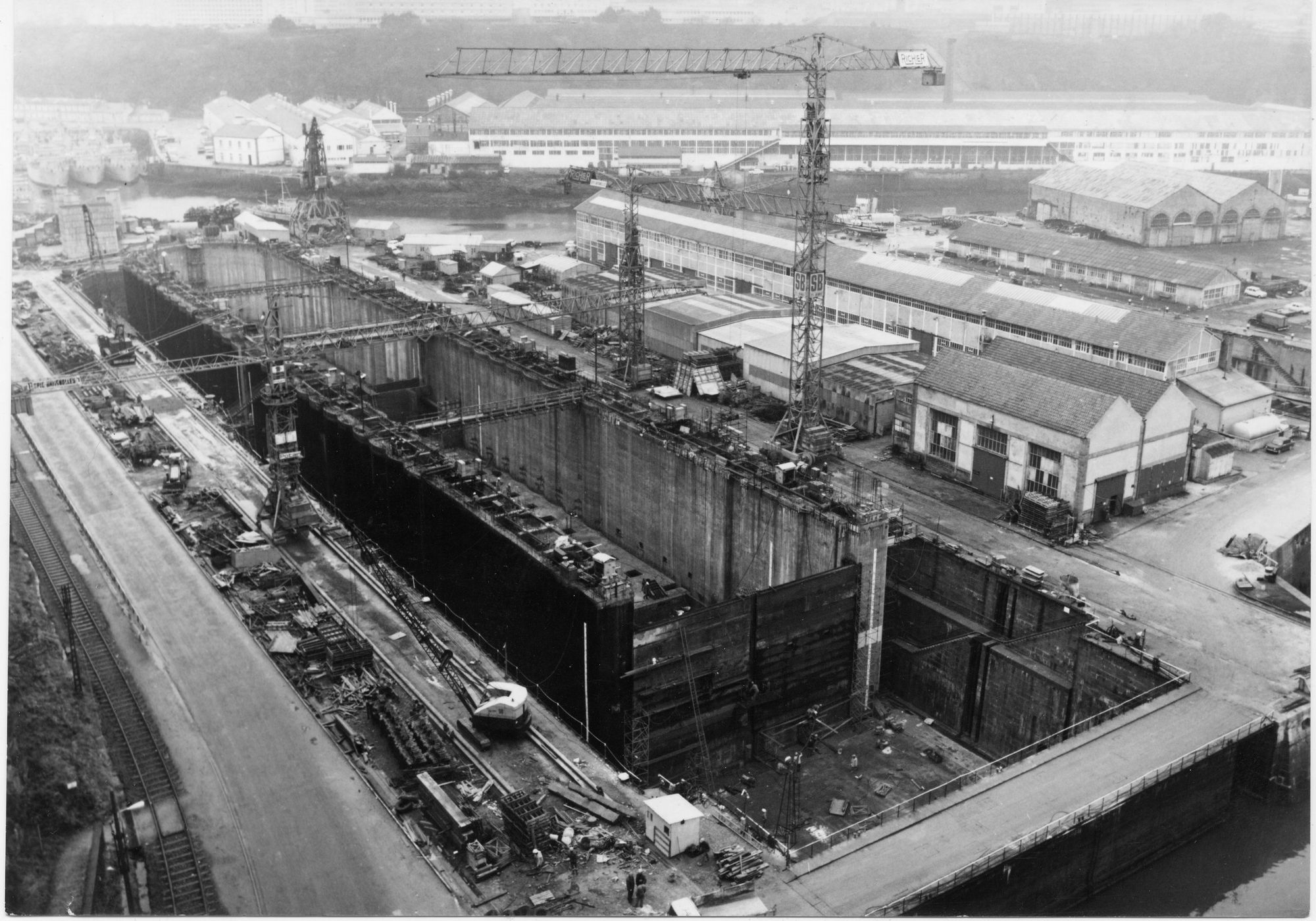
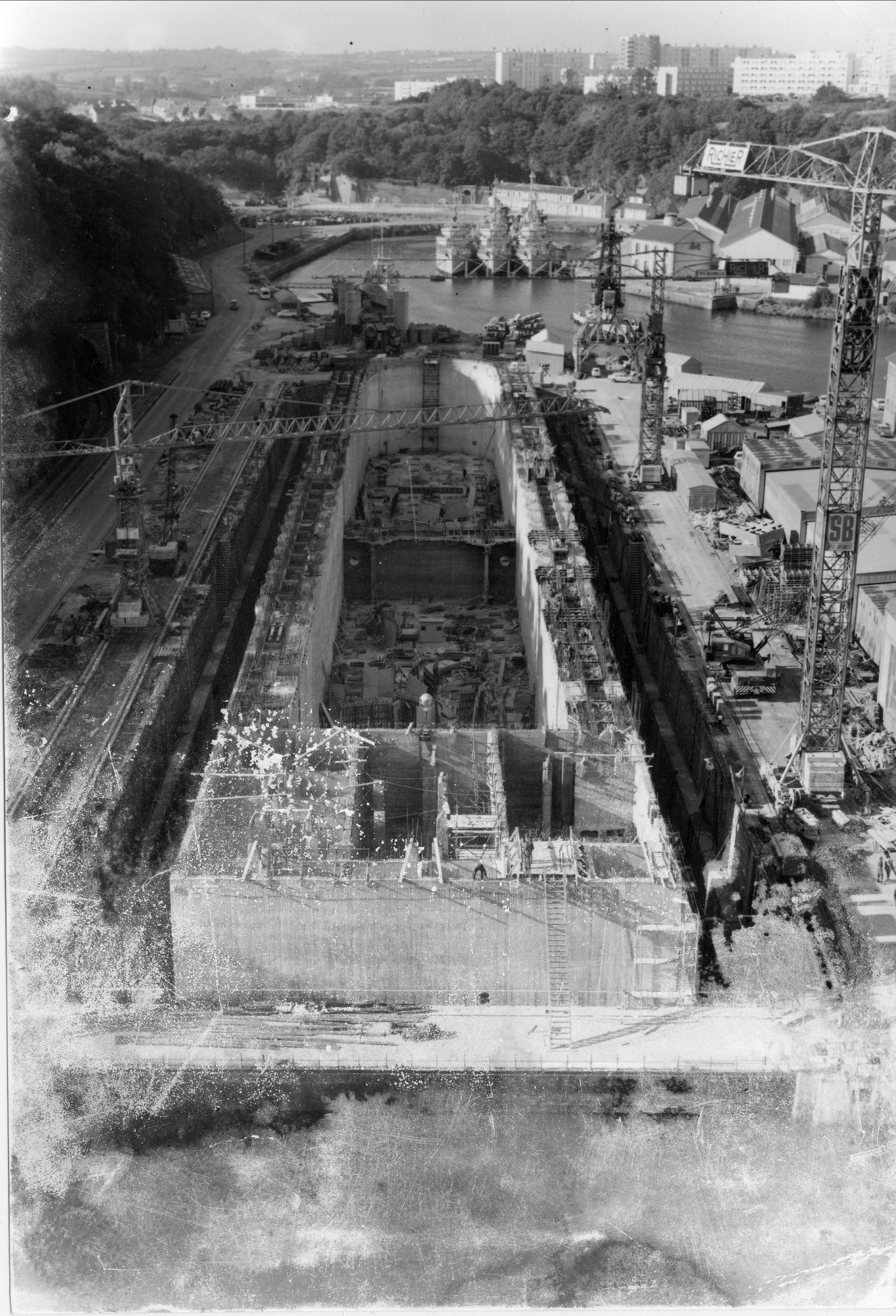
Catalogue number Construction of drydock number 10, 1972 The Redoutable class of balistic missile nuclear submarines were in service from 1971 and it was necessay to have a dedicated maintenance and repair base for these submarines in Brest. Note shuttering on the left wall of the partially-constructed drydock. It is difficult to know whether the structure at the entrance to the drydock is the final lock gate. cm x cm Gelatin silver print |
 |
|
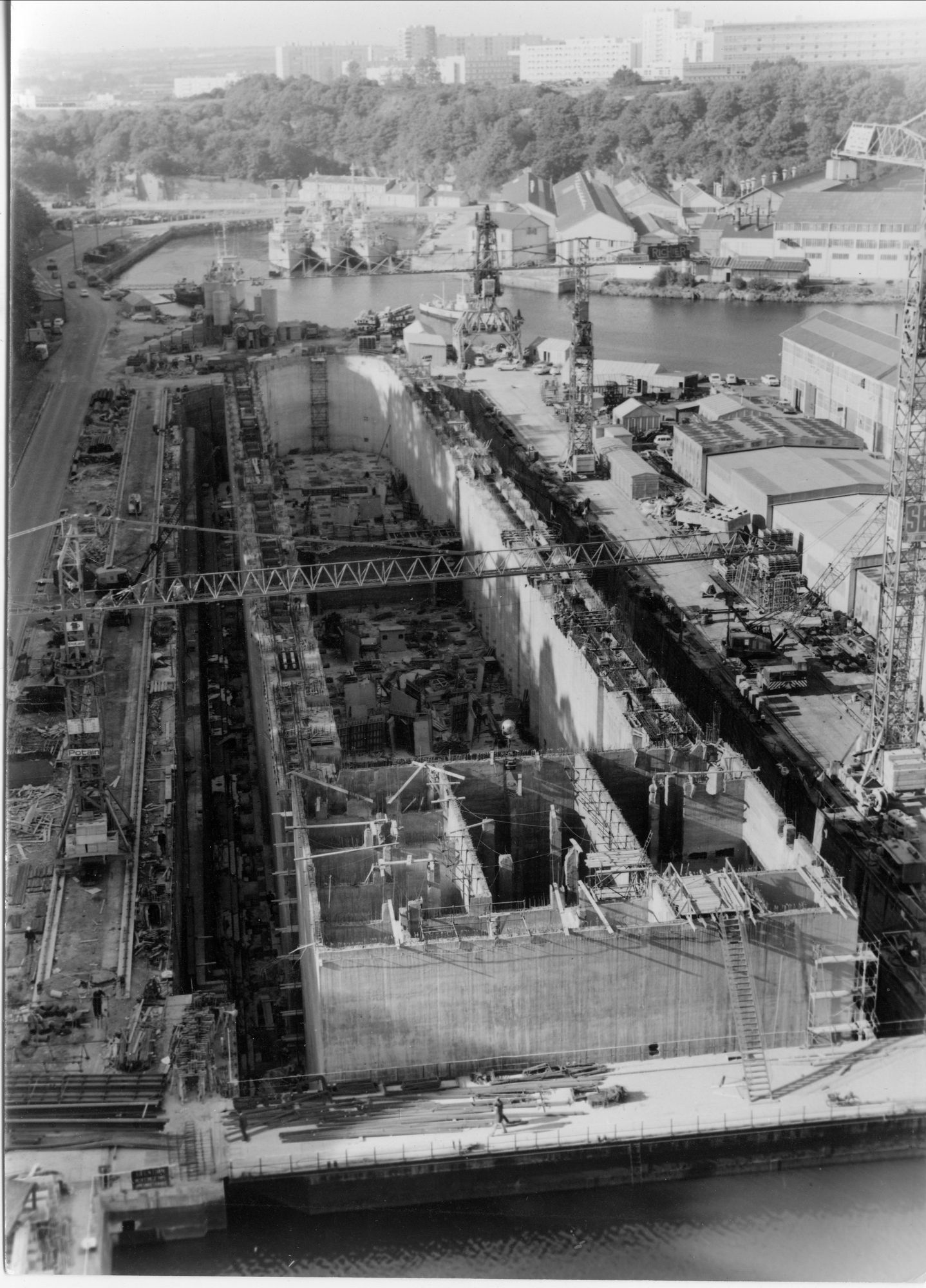
Catalogue number Construction in number 4 drydock, 1972 The drydock number 10 is nearing completion. The box-like structure at the entrance is something of a mystery as it does not appear in later photographs, is it a mobile floating lock gate, for example? . cm x cm Gelatin silver print |
 |
|
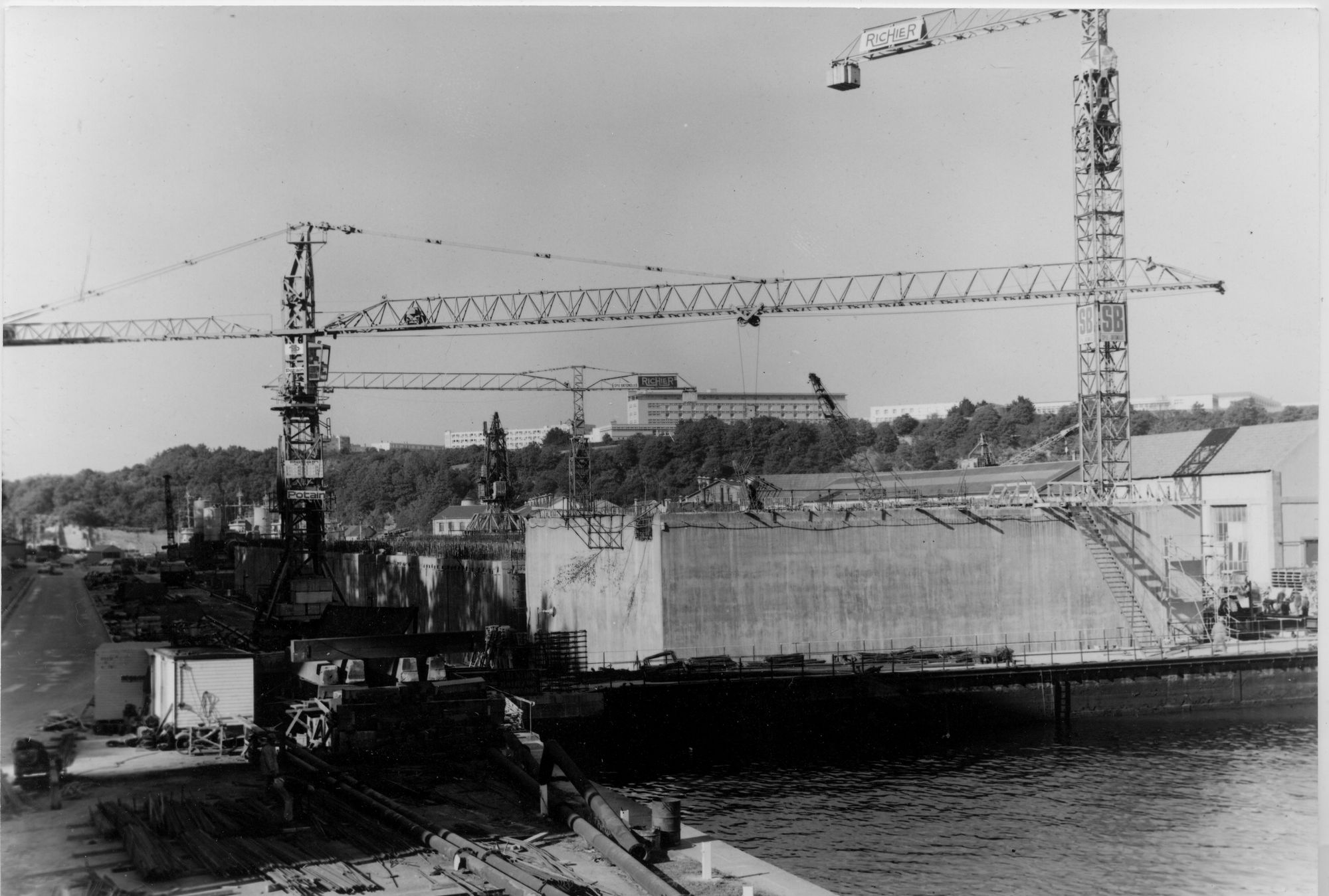
Catalogue number Construction in number 4 drydock, 1972 Another view of the drydock and the box-like structure. Note the installation for making concrete at the far end of the construction site. Once finished, the structure was floated out of the drydock and moved to the roadstead to then be sunk onto a bed of ballast. cm x cm Gelatin silver print |
 |
|
Catalogue number Construction in number 4 drydock, 1972 A general view of the construction site with the unidentified box-like structure in the foreground. cm x cm Gelatin silver print |
 |
|
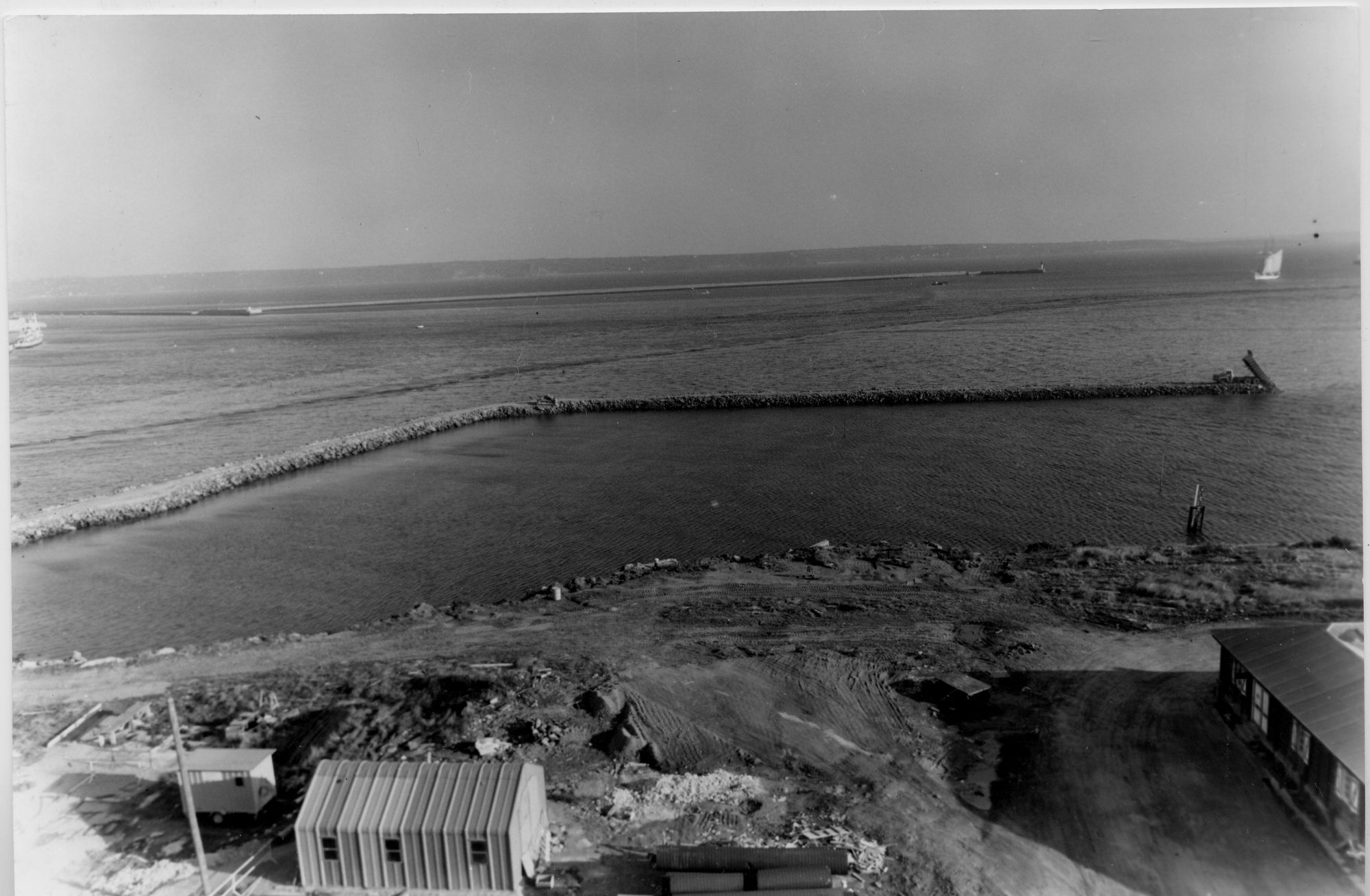
Catalogue number Creation of the submarine maintenance base The nuclear submarine maintenance base was constructed on reclaimed land in the Greve aux chiens. cm x cm Gelatin silver print |
 |
|
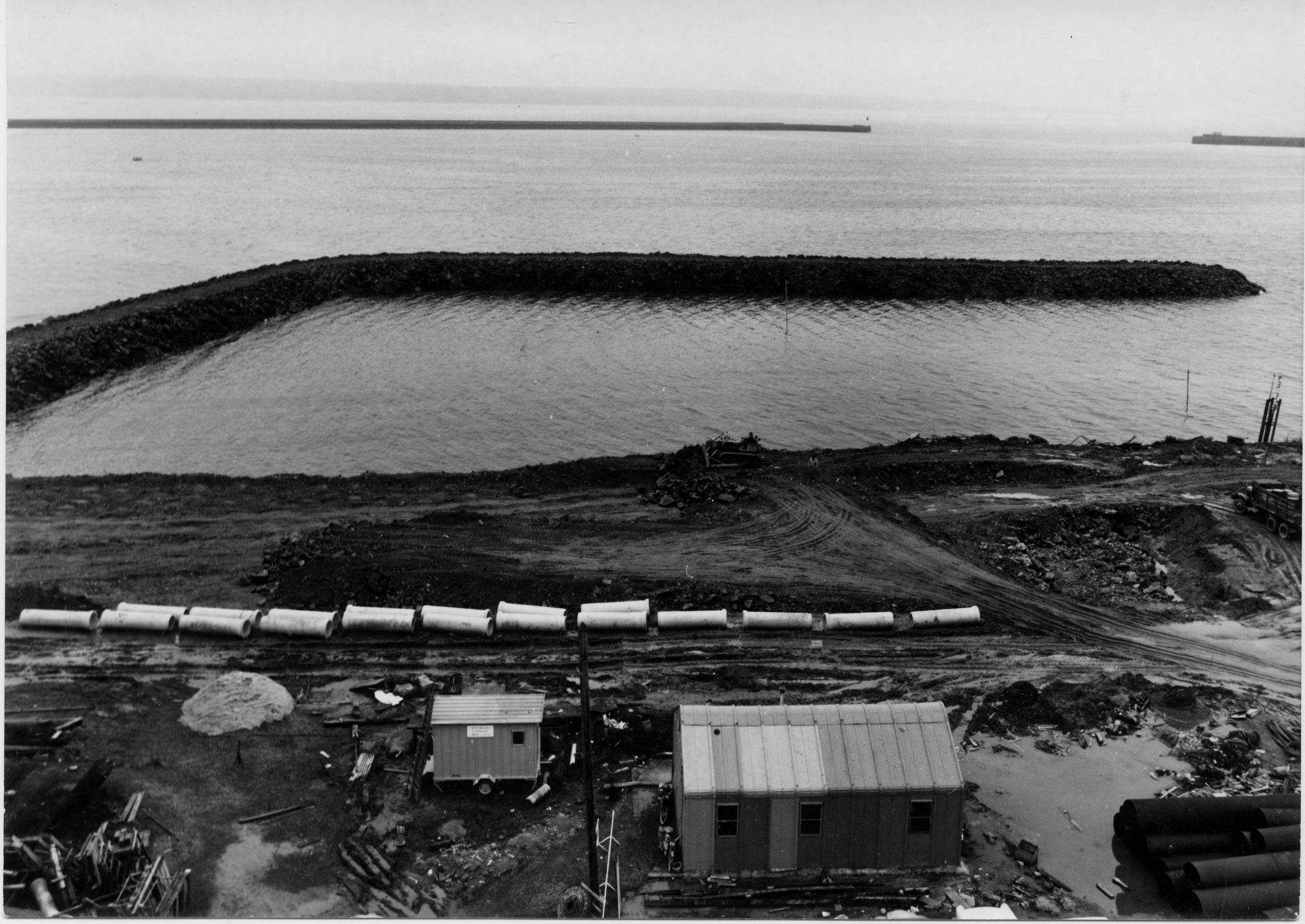
Catalogue number Creation of the submarine maintenance base The area to take the drydock has been delimited, note the bulldozer center. cm x cm Gelatin silver print |
 |
|
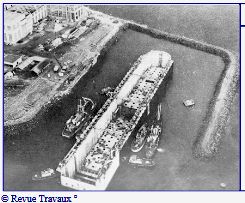
Catalogue number Floating the drydock into place Although of poor quality, this image shows how the drydock was moved into position by several tugs. We cannot see whether there is any proper lock gate closing the drydock and the box-like structure is nolonger visible. Credit: Journal Travaux, 1974 Digital image taken from "https://www.planete-tp-plus.com/fr/IMG/pdf/Formesradoub_cle797835.pdf" |
 |
|
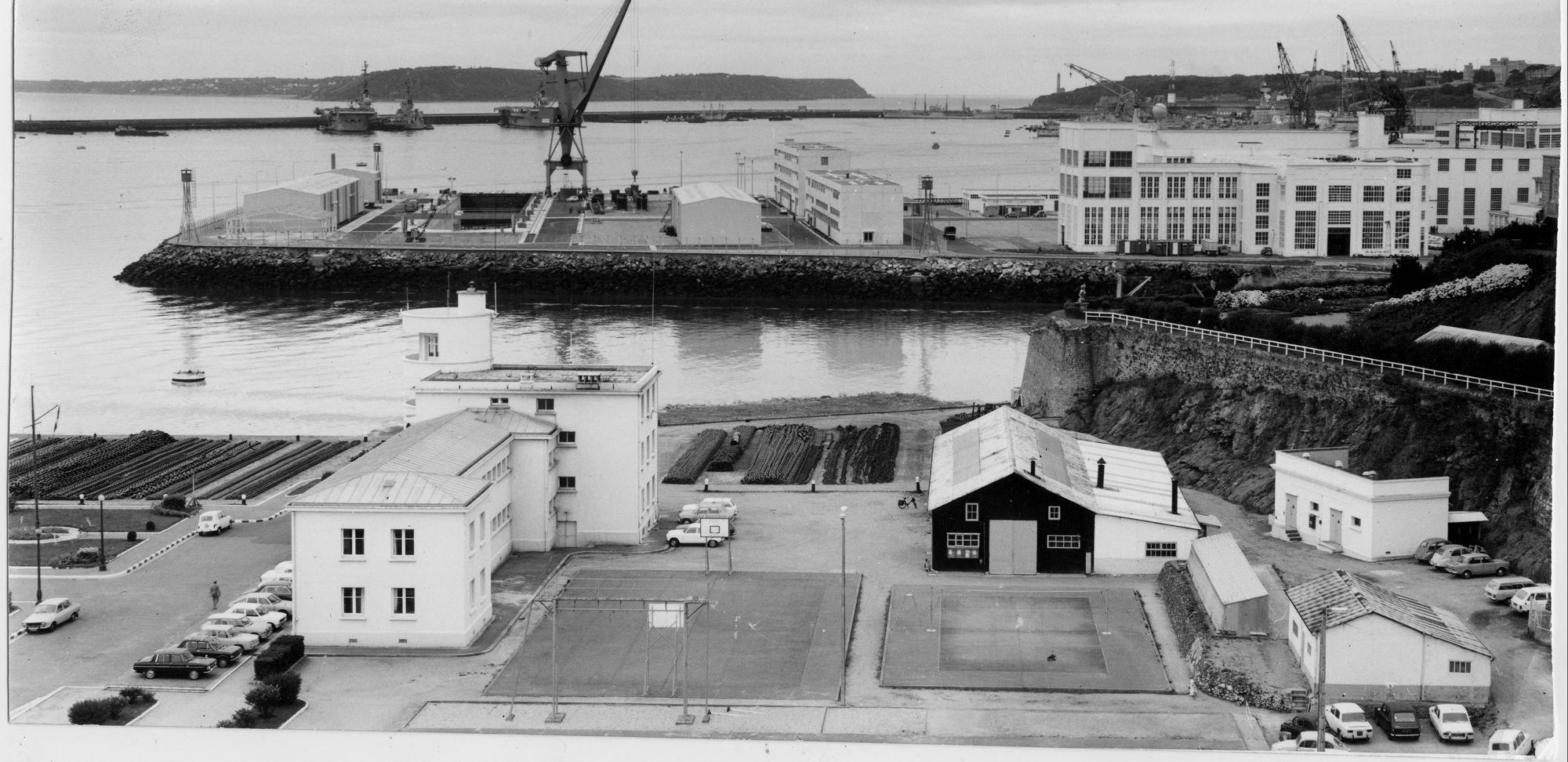
Catalogue number The completed submarine base The new drydock and its dockside facilities were for the maintenance and repair of the first-generation ballistic missile submarines. The drydock and its cranes were demolished from 2024 onwards, the installation had become obsolete with the withdrawal from service of the first generation nuclear submarines. Note Foch and Clemenceau in the background. cm x cm Gelatin silver print |
 |